Showing posts with label Skyrim. Show all posts

Sunday, December 13, 2015

#101: The Evolution of Bethesda Leveling Systems


Fallout 4 has been making waves in the gaming community since its release. People have been singing its praises on many fronts, including the town building, crafting, improved character animation, and voice acting. Another area of accolades is in the leveling system. More than just a new and unique way to streamline one the most fundamental RPG mechanics, Fallout 4's character development system represents an evolution in how Bethesda empowers its players.

In order to understand what that means, we must first take a look at its predecessors. Oblivion, being Bethesda’s first open-world RPG with no dice-worlds and fully realized combat, makes a fine starting-point for our purposes. Character progression in Oblivion was unique compared to most other RPGs of the time. When the player creates their character, they select 7 of the game's 21 total skills, which become their major skills. Skills increase as they get used (ex. the Swords skill will go up the more the player uses bladed weapons). After increasing their major skills enough times, the player can level up by sleeping in a bed.
Then, they can choose three stats to increase. Stats, like skills, are measured from 1 to 100, and can increase in increments of +1 to +5. The exact increment depends on how many skills that use the statistic were increased since the last level-up. Swords, as an example, are governed by Strength. By increasing the Swords skill, the player is increasing the amount that Strength will be raised if they choose to increase Strength when they level up.
Now, if you haven't played Oblivion before reading that explanation, that might sound more like legal-ese than the way characters progress in an RPG. There is a very good reason for that. A common complaint about Oblivion, in hindsight, is that this system was overly-complicated. In order to make a decent character, one had to be extremely careful about what skills they trained and when, lest they only get small stat increases. The fact that enemies scale to the player character's level, and that every stat bonus they receive is always +5, gravely exacerbates this problem. Their equipment also grows stronger, to the point where no-name bandits will accost players for 5 gold while wearing highly protective, expertly-crafted armor worth thousands.
On top of that, the enemies dotting the open-world would be replaced by stronger monsters with more powerful skills as the player grew stronger. When starting the game, players are often accosted by wolves and other forest animals. While annoying, these creatures are more of a minor nuisance than anything else. After getting to about level 20 or so, those woodland beasts are exchanged for Minotaurs, which are significantly stronger, faster, and more relentless. Later, even more ruthless Minotaur Lords take their place. As a result, it’s not just that leveling up leaves players with even lower stats than their foes. Those same foes are also being thrown to the wayside so that even more terrifying enemies can litter the field. This problem is so bad that not only are there detailed guides for how to level, but some of them even advocate not leveling up at all as a reasonable solution. After all, unless players are willing to meticulously study and train specific skills in particular orders, leveling up will almost leave them in a worse position.
Despite its problems, Oblivion did serve a purpose. It brought skill-based, real-time to the open-world format, doing away with the invisible dice-rolls of its predecessor Morrowind. The radiant-AI that gave all NPCs set schedules also breathed life to the world (if you ignore the absolutely hideous faces and voice-acting). It wasn’t stellar, but it’s a base. Crucially, it is a base that can be modified and built-upon to create something significantly better.

Using their now-established open-world format, they were going to bring Fallout to modern audiences with Fallout 3. With a new property comes new progression systems. Though similar to Oblivion, Fallout 3 had a more standard leveling system. Like Bethesda's previous game, characters’ abilities were quantified by a combination of individual stats and skills. However, instead of building up their stats as they developed, players chose them at the start of the game, and mostly stuck with them. As they adventured, their character would gain experience and eventually level up. Of course, that is when the player spent points to increase their skills. More importantly, they selected a perk. Though skills go a long way towards determining what one can do, they are only half of the equation. The perks also go a long way in effectively defining a Fallout 3 character. Each one comes with a powerful benefit, from increased stats or skills to stronger critical hits and even new dialogue options to take advantage of. These passive benefits, combined with skills and stats, give a holistic, yet easy to comprehend, view of a character’s abilities.
There were obvious advantages that the Fallout 3 system had over Oblivion's. Firstly, it eliminated the need for meta-gaming that came from Oblivion. Stats were basically determined at the very start of the game, and there was no need to train skills individually since the player can allocate skill points at level up. This meant that players didn't feel pressure to modify their playstyle in order to stay ahead of the enemies. Maximizing a character's performance by researching and planning a build was purely optional, instead of being damn-near required to keep up.
More importantly, this simplified the process of character development when compared to Oblivion. Players gain experience, level up, then acquire skill points and a perk before beginning the process all over again. Though one might expect that adding the variables of perks and perk requirements would further complicated the system, the fact the progression is so transparent and plain compared to Oblivion makes it easier to understand what is going on. By glancing at any given character's skills and perks, it is simple to intuit what kind of character they are, and how they are likely to develop in the future.
The problem of enemies scaling out of control was also corrected in two ways. First, all characters use the same number of stat points, which are by and large locked in from the very beginning of the game. Furthermore, the number of skill points both players and enemies acquire on level up are based on the Intelligence stat, and nothing else. In this way, the enemies’ skills increase at roughly the same rate as the player’s skills, give or take a few points difference in Intelligence. Given that players are often continually augmenting themselves with new perks and equipment, this gives a total net benefit when leveling up, even if they don’t choose an “optimal” build.
The other, less obvious measure Bethesda took when level-scaling is to control how it occurs in the game world. In general, the world scales with the player as one would expect. As the player grows stronger, so too do enemies through the wasteland. This changes slightly when new locations are discovered. By finding a new place to explore, the enemies in and around that area get locked to whatever level the player was at the time.
Immediately after leaving the vault, many players, for a number of reasons, don’t follow the road to Megaton and instead head to the nearby Springvale School. As a “dungeon”, for lack of a better term, Springvale is filled with raiders. By finding it this early on, players will lock the enemies there to level 2 or 3. At this point, a large subset of these players will realize their mistake and run away. After completing quests and getting a little stronger, to around level 5 or so, they may desire to go back to Springvale to extract bloody revenge on the raiders that previously humiliated them. Although the world has scaled to level 5 in the meantime, to match the player, Springvale has not. It was previously locked to level 2, where it remains.
In Oblivion, players could level up a similar way that the above player could in Fallout 3. However, if they did, and returned to a dungeon this same way, they would likely find that it grew harder due to a combination of the level-scaling and enemies acquiring stronger gear. By locking-in a location’s level when it’s discovered, Fallout 3 makes it possible for a player to realize they are outnumbered and out-gunned, then take steps to get stronger and try again, that they may succeed where they once failed. This system worked so well that Skyrim and Fallout 4 would continue to use it in the future.
Bethesda learned their lesson when developing Fallout 3. By building off the foundation of Oblivion, working in some of the design principles of early Fallout games, and mixing in their own observations from the reception of Oblivion, they unknowingly began to embark on a journey of streamlining a simplifying RPG mechanics.

Later, when they returned to their iconic Elder Scrolls series with Skyrim, they continued this journey by overhauling the way characters developed in Oblivion. Players still need to use a skill in order to increase it. However, these skills are no longer governed by stats. In fact, stats aside from Health, Mana, and Stamina are gone. Whenever the player improves one of their skills, they gain experience which goes toward leveling up. Advancing a level allows the player to increase Health, Mana, or Stamina and gain a point which can be spent on a perk.
Yes. Inspired by their experience developing Fallout 3, Bethesda added perks to Skyrim. Attached to each skill is a perk tree, which lists each perk that falls under that skill, and the prerequisite perks and the minimum skill requirements to take the next rank in each one. Each individual perk costs a single point. Players can purchase any perk that they meet the preconditions for, but may also choose to save up their perk points if there is nothing they wish to acquire.
This is important, because it solves a problem that cropped up in Fallout 3. When the player goes up in level in Fallout 3, players are forced to take the skill increases and perk immediately. Occasionally, players in Fallout 3 find that they do not want any of the perks available to them. However, they are still forced to choose one of them to apply to their character. Since skills are trained with repeated use in Skyrim, the odds of this happening are significantly greater. By allowing players to stock up perk points, this problem is deftly avoided.
Yet despite how simple the system is, there was a noticeable drawback. Skills that had no perks invested into their skill trees were practically useless, no matter how much they were trained. I very clearly remember a character that I had played in Skyrim that bests demonstrates this point. By utilizing an exploit, I was able to quickly raise each of his skills to 100. However, I had chosen to focus his perks in Stealth, One-Handed, and Illusion above all else. When I tried to use Destruction magic, despite having a skill rating of 100, the effects of those spells were so minimal, and their Mana costs so high, I might as well have been meekly shoving my enemies for all the damage I was doing. This is because I had not invested in Destruction perks which increase damage and decrease Mana costs. Though the skill ratings did have a slight effect, they were absolutely worthless without perks.
But that on its own isn’t the problem. When I tried using Destruction-magic with that character, it was really more of an experiment, to see how well my supposed “master-wizard” could actually cast without perks. The problem here is that this system asks, especially later in the game, for players to use skills that they wouldn’t otherwise want to use, in order to acquire points to spend on perks in skills they do want to use. I didn’t raise my characters stats to 100 in order to become a god in a mortal vessel. I did it so that I could get the perk points needed to be a better dagger-wielding, illusionist thief. Without the perks afforded by raising these skills, and thus my character’s level, it’s harder to justify taking perks that aren’t core to my character, but are otherwise useful, like Smithing and Enchanting. Investing in them would eat away at perks I can use on my most useful skills.

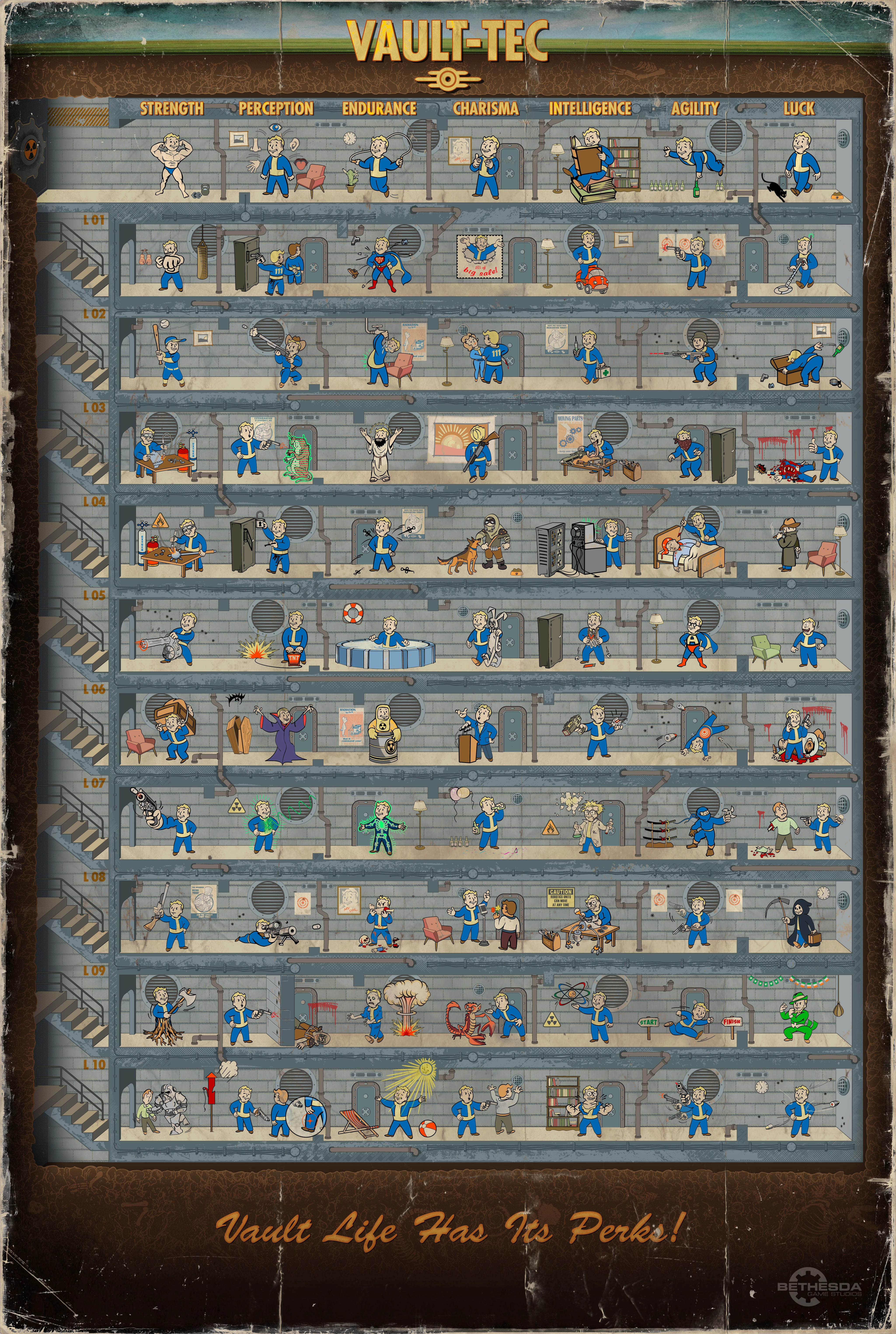
This might explain the approach taken in Fallout 4. Like Skyrim before it, Fallout 4 attempts to simplify and streamline the leveling process. Rather than go the same direction Skyrim took, Fallout 4 used a different technique more suited to the trappings of the franchise. Instead of removing stats and using skills/perks to determine what a character can do, Fallout 4 opted to remove skills, and use only stats and perks.
At the start of the game, the player is given a set total of points that they can apply to their 7 base stats. These stats determine how much health the player has, their maximum carry weight, their ability to make critical hits, etc, as they did in Fallout 3. Experience, as is also the case in the previous Fallout, is earned by exploring the world and doing what comes naturally. And, as Skyrim players would be familiar with, a point is gained on level up. This point can be spent in several ways: The player can choose to take a new perk or advance a rank in one they already have (assuming the meet the requirements) OR increase one of their base stats by a single point.
Perks also function somewhat differently to accommodate this new system. Each perk corresponds to a prerequisite rank in one of the base stats, without which one cannot take them. Strong Back, as an example, is a perk which raises the player's maximum carry weight. It is the Rank 5 Strength perk, and cannot be taken unless the character in question already has 5 points in Strength. Every perk also has multiple ranks, which provide even bigger bonuses, and these are gated off by the current level of the player character. Rank 2 of Strong Back, to continue our example, increases the benefit of Rank 1 and can only to taken once the player is level 10 or higher.
Even more than in Skyrim, this means that any given player's build is closely tied to what perks they have. By looking at what perks one has taken, it is easy to tell what kind of playstyle they have and/or are going for. The character I played has 5 Ranks each in Rifleman and Sneak, along with 3 Ranks in Sniper, Better Criticals, and Grim Reaper's Sprint and 2 Ranks in Action Boy and Ninja. Someone who has never played Fallout 4 has no idea what any of this means. To one who has played Fallout 4, and even to some who have only placed Fallout 3 or New Vegas, this tells them that I like to abuse VATS to get tons of Sneak Attacks and Critical Hits from a distance using scoped, non-automatic rifles. It also gives a rough idea of what stats I'd need to have in order to acquire all of these perks, since each one has a minimum requirement.
It also solves the problem that Skyrim had where skills and perks weren’t always in alignment. Since skills don’t exist, the “master-wizard” problem I outlined earlier from Skyrim is no longer an issue. As a result, the player character’s abilities are more accurately reflected by their stats and perk ratings than their skills in Skyrim. Perks are also dependent on having a minimum stat rating before they can be taken, increasing the likelihood that stats will correlate with the perks acquired. This all results in a cohesiveness of character absent from the higher-level Skyrim characters.
But despite that, there is still some noticeable room for improvement. Even if the concept behind the perk trees is extremely simple, Bethesda didn't give much in the way of tutorial for how to use it. If one didn't follow the pre-release materials that explained how these systems worked, as I had, they could easily be forgiven for not understanding the system. By looking at the in-game perk chart, it is easy to see why so many assume that they need to get a given stat's perks in order, from top to bottom. The chart makes it seem like such linear progression is necessary. Because of this, it's possible to put points in perks one does not want or need not knowing that they can easily bypass them to get the perks they want if they have high enough stats. The combination of the graphic designer and the lack of tutorials conspire against the player.
The another primary issue is that leveling-up doesn’t feel as meaningful as it did in previous Bethesda games. The only thing players gain at level-up is the perk point, and a few extra hit points. To compensate for this small reward, level-ups are much more frequent than in previous games.
In Fallout 3 and Skyrim, leveling up felt like a special event. After enduring many tough trials, Fallout 3 characters were rewarded with the chance to strengthen their skills and obtain a unique bonus for themselves. And although Skryim also gave only a perk point and some bonus health/mana/stamina on level-up, the skill training required to grow stronger was a reward itself. Not only were the rewards more substantial, but they came infrequently that the player could eagerly look forward to the next time they built up enough experience to see that screen just one more time. Perks, and thus levels, have to arrive at increasingly frequency in Fallout 4, depriving players of their dopamine fix.


Fallout 4's level system isn't perfect, but it is another step in a long journey that Bethesda started in 2006 with Oblivion. For better or worse, Bethesda has been focusing on refining and streamlining the mechanics in their games, the leveling system being only one prominent example. Even if there are some flaws, one must appreciate the desire to experiment and improve these systems. Once people have had enough time to properly digest Fallout 4, I have no doubt that we will discover flaws that have been otherwise overlooked at the time of writing. It will be interesting to see what Bethesda does in response to these criticisms, and which direction they’ll along this road to refining their mechanics.

Wednesday, April 29, 2015

The Texture Pop: Episode 38: The FUSE Experience


0:02:19 Viewer Question
What would be your ideal Star Wars game?
This was written in lieu of the trailers of both the new Battlefront game and Episode 7. Also, I need to make clear that Star Wars is not a franchise that appeals to me, so if my opinions are seen as heretical to fans, it's not something I can help. This is in regards to both the movie and game discussions.

And remember, if you have questions and/or comments that you'd like us to read on the air, you can do so at thetexturepop@gmail.com


0:21:15 Gaming News
Skyrim allowed paid mods on Steam.
For the record, we recorded this podcast on Sunday. By the time of this writing, paid Skyrim mods have been removed. So I kinda have to put my foot in my mouth regards to the apocalyptic tone expressed during this segment. Still, I stand behind the opinions expressed on this subject. It's a well-meaning idea, but Valve didn't really think too much about what the implications were behind such a massive, overnight change.


0:39:55 Garrett talks about his week.


1:03:00 Sam sells furniture (and reads The Fault in Our Stars)
As someone who follows John Green online, I really need to start reading his books. They seem like they'd be right up my alley.


1:09:40 Sam played portable games (while selling furniture)
In particular, he played Muramasa: Rebirth, Persona Q, and Crimson Shroud.
It's nice to hear Sam make similar criticisms that I made when I played Persona Q. I even wrote an article about it way back when.


1:21:00 Sam got into Monster Hunter and God Eater: Burst
As our resident Dark Souls player, I'm not really surprised these games would interest him.


1:34:50 I finished Pillars of Eternity.
It's like Baldur's Gate 2, but without all of the stuff that makes me hate Baldur's Gate 2.


1:46:00 I watched Dollhouse by Joss Whedon
It's a darkly interesting series. Though only 2 seasons long, it did more than many other shows have managed in 5 seasons.


1:50:00 Sam, Chris, one of my friends, and I played Insomniac Game's FUSE
Dear god, that game. We're going to keep going, but it's going to be painful.


2:09:00 Chris played more South Park: The Stick of Truth


2:22:50 Wrapping Up

Saturday, May 17, 2014

#70: Factions in Video Games: Skyrim vs. Final Fantasy X-2

I am a person who likes RPGs of many sorts. As a result, I see many different implementations of the same ideas by multiple companies. One such concept many RPGs utilize is a faction system, where multiple groups of opposing ideals go against one another, usually having fairly drastic effects on either the main plot or the world at large. I tell you this because I am about to make a bold, controversial assertion: Final Fantasy X-2 uses the concept of opposing factions significantly more effectively than The Elder Scrolls V: Skyrim. I know that will come across as absurd to many of you, because Skyrim is very well loved and Final Fantasy X-2 is... not. However, I do have my reasons for thinking this.

My first reason for saying this is that the factions in Final Fantasy X-2 are a lot more relatable. In Skyrim, the game does a very good job at explaining the negative sides of each faction. However, the positive aspects of each faction are a lot more hidden from view. At the beginning of the game, a captain of a group of soldiers belonging to the Imperial Legion attempts to execute the player for the crime of being in the wrong place at the wrong time. This tells the player that the bureaucracy of the Legion can often lead to corruption and overlooking simple mistakes, without much of a need for exposition.
The Stormcloak introduction does not fair much better. When arriving at Windhelm, the Stormcloak capital city, players find that Stormcloak soldiers are mocking and oppressing the Dark Elf and Argonian populations of the city. Through this interaction, the game informs the player that the Stormcloak faction discriminates against other, non-Nord races. When it comes to the good sides of these factions, we do not have similar scenes. All of it is gleamed through exposition told to the player by characters who are in those factions. The player is not shown these strengths, they are told. This makes in that much more difficult to envision these strengths. So, when it comes to time to select a faction, players choose between the lesser of two evils rather than which one harbors beliefs more in line with either their philosophy (or that of their character's).
This is not the case with Final Fantasy X-2. In that game, both of its major factions are presented in more positive spotlights. When players first make contact with each faction, characters from that faction come up to talk about their group and what they believe in. There are friends, both new and from Final Fantasy X, who are on each side. This gives players, especially ones who played Final Fantasy X, legitimate reason to invest their time with each faction and getting to know them. Reaching the Youth League headquarters in rewarded with a discussion on channeling youthful energy towards progress and building a better future. On the other hand, the New Yevon members talk about how apprehensive they are towards the accelerated pace of change, and their wish to take things more slowly. In this way, players are left to ponder which faction they support based on what beliefs each group holds rather than which one is the lesser evil. Although both factions have scenes where they are shown in more “villainous” lights, those are few and far in-between when compared to Skyrim's factions.

Which brings me to my second point: The faction-based choices players make in Final Fantasy X-2 have significantly greater impact than similar choices made in Skyrim. When participating in Skyrim's Civil War questline, players are forced to choose between one of the two major factions and side with them in the war. However, regardless of the decision, most players will end up performing the exact same tasks for each faction. Forts will need to be taken over, cities will need to be captured, crowns will need to be obtained, and enemy faction leaders will need to be eliminated no matter which side is selected. Further, there are no real changes on the world when players finish the questline for either side. A few guards might comment on it when running around in the city, but the world at large does not seem care about the outcome. Players might see more/less Imperial/Stormcloak troops in certain areas, but they will look and act the same as any city guard would. Nothing happens and nothing changes in Skyrim's static world.
But in Final Fantasy X-2, players actually see the consequences and effects of choosing to throw their support behind one of the two factions. After getting about 1/5 through the game, the game forces the party to decide which group is worth their time. This choice is actually a very crucial one. Side-quests open and close depending on which group the player sides with. For example, the Youth League has a quest where players can assist them in fighting off fiends if they decide to align with that group. Characters in the story will comment on the choice the party makes. Certain aspects of the game's main story will even change to reflect this one decision. In the finale of Chapter 2, the group is required to infiltrate the New Yevon headquarters. If they sided with New Yevon, then they just stroll passed the guards. Otherwise, they will need to fight their way through. It feels like that one choice has a big impact. Compared to how Skyrim mostly ignores the choice of faction, this is a huge step up.


While many people would scoff at the idea of Final Fantasy X-2 being superior to Skyrim, even if only in a single aspect. However, a close look at the details behind these games reveals that my assertion at the beginning of this article holds merit. Though many people are right to enjoy the intricacies of Skyrim, the game has its flaws and this is one of them. Not to say that Final Fantasy X-2 is a perfect game either. No one in their right mind would say that. This is just one thing that the game gets right. Factions are a great way to quickly establish conflicts, plot, and gameplay elements. Done well, they can add to a world and player interactions with it. Done poorly, they cannot accomplish much of anything. Those of you interested in game design would do well to keep that in mind.

Thursday, January 9, 2014

#68: Kingdoms of Amalur vs. Skyrim: The Intimidation Factor

Like many people out there in the gaming space, I like to try to play games to completion. Though I do that with fewer and fewer games as I grow older, those games that particularly interest me still fuel that urge to do everything I can before moving on. Because of this, I am all too familiar with some of the frustrations that come from such a playstyle. Open-world RPGs can be either great or horrible for people like myself. On one hand, we always have something to do, because those kinds of games will almost always have a quest or two hidden away for players to find. However, completions like me are never able to completely move on from them, because those kinds of games will almost always have a quest or two hidden away for players to find. Despite this problem, this genre can be implemented in ways that can either exacerbate this feeling or lessen it in people.

Two open-world RPGs in particular are the subjects of this weeks article: Kingdoms of Amalur, which I recently got finished playing, and The Elder Scrolls V: Skyrim, one of the most successful games in the Elder Scrolls franchise. I want to talk about these two games in particular for a very special reason. Both games have tons of content. So much so that players could spend hundreds of hours playing either game and still never be able to complete it all. However, when I think of trying to do everything in Kingdoms of Amalur, I can't help but be intimidated by the thought. Not because any one piece of content is particularly overwhelming, but because I feel that it will take so much time, become so boring, and progress will be so slow that I just lose any desire to keep playing the game. At the same time, the thought of exploring the land of Skyrim, despite all the criticisms I have levied at that game over its lifespan, fills me with delight. Just writing about it now makes me want to go back, reload my save, and keep exploring the land to look for all the things I undoubtedly missed. At this realization, I sat down and thought for a bit as to why that might be.

The first explanation I came to for this is that Kingdoms of Amalur makes the sheer wealth of content available much more obvious than Skyrim does. When traveling through a given area in Kingdoms of Amalur, players will often come across bright yellow question marks on the map. Each of those symbols represents a quest which the players can stop to complete. This means that a player can gauge exactly how many quests are in given area by just filling out the map and counting how many yellow question marks show up. This is in fairly stark contrast to Skyrim. In the latest installment to the Elder Scrolls series, players are not explicitly told where or how to find quests. Players need to talk with people in towns or settlements in order to obtain quests. While sometimes NPCs in the game world will come up and petition the player character for assistance, the player themselves will generally be the one who has to begin interactions in order to discover new content.
Though these two systems lead to the same end, in which the player discovers quests and content to do, they accomplish different things in the mind of the player. In the case of Kingdoms of Amalur, all the content is made readily apparent to the player. In Skyrim, the exact amount of content is obfuscated. So when I go into an new area in Kingdoms of Amalur, I think to myself that this could be a potential 6-7 hours sitting right here just doing missions completely unrelated to anything else in the game. Entering a new town in Skryim, I can complete whatever errands I need to run and talk to a few villagers to find some quests I need to do. Without the constant reminder that there is a new thing to do in the city, it is easier for me to trick myself into thinking that I have “completed” all the quests in town, when in truth I have barely scratched the surface. Nonetheless, I walk away with a feeling like I accomplished much. In Kingdoms of Amalur, when I finish a quest, I feel like it is just a drop in bucket because I can see another 3-4 quests just in this one grassy plane. It is a subtle shift in the way it makes players think, but a key one that affects the perception of the whole game.


Another contributing factor to the difference in feeling of intimidation in one of these games, but not the other is that contrast in how combat works in each of them. In Kingdoms of Amalur, the combat is very visceral. There is a surprising amount of depth to it. Players need to stay aware of their surroundings in order to dodge enemy attacks, while trying to create an opening to stagger the enemy. If they are not careful, then they themselves will be knocked down and on the defensive. Each weapon type has its own combo chain, with strength and speed unique to that type of weapon. Though not difficult, timing and planning are quite important, and even enemies of equal level can wear down the unprepared (especially when there are mages in the enemy formation). On the flip side, Skyrim's combat is quite bare bones. It is quite trivial to button mash one's way through most encounters the game will throw at the player. Magic and stealth characters can use spells and backstab to change things up, but the mechanics are fairly simple and do not need much knowledge to fully grasp.
Let me preface my next statement by saying that I enjoy the combat in Kingdoms of Amalur. In fact, the combat was one of the most enjoyable parts of the game. However, that kind of combat against dozens and dozens of encounters has a way of gradually draining the player's mental stamina and enthusiasm for playing. As fun and fairly easy as it is, the sheer number of enemies the game throws at the player are not quite compatible with the type of combat. Also, the foes in Kingdoms of Amalur are quite durable, so taking them down can be fairly time consuming. While Skyrim also tends to have a lot of enemies come the player's way, the simpler mechanics lend themselves to that more readily. Enemies tend to fall fast and easy. It is not as mentally draining to play through waves of enemies in Skyrim than it in Kingdoms of Amalur, so playing through it is more bearable, despite its combat being worse overall. As a result, it is much easier to play hours and hours of Skyrim than in is to do the same in Kingdoms of Amalur. I can also play the latter for an hour or two before I feel the need to save and shut it off.


I find it interesting to compare and contrast similar games, because there is much to learn from such analysis. Both games are likely in many ways, but the way they implement their systems can leave completely different impressions of the audience. What is even more interesting is that I know there will be people who disagree for many different reasons. I am sad that Kingdoms of Amalur did not do so well, because I think they could do so much better if given a second chance. Hopefully, people will be able to learn from what went wrong with the game in time. Until then, there will be guys like me out there to over-analyze games like it in the vain hopes that others will listen.

Wednesday, March 27, 2013

#59: The “Essential” Problem With Skyrim


A few days ago, as of the time of writing, I had a conversation with my friend Aldowyn discussing The Elder Scrolls V: Skyrim. The particular topic for discussion was an often contested feature of Skyrim's design, the use of the “essential” flag. As many of you are no doubt aware, non-player characters in the game who are involved with any of the game's vast number of quests often receive the distinction of being marked “essential” by the system. This distinction gives such NPCs and inability to be killed by anything in the game, even the player. The reason such a mark would exist in Skyrim, just as it did in it's predecessor Oblivion and the third main entry in the Fallout franchise, is so that their exists no possible way for the player to miss out of any of the quests offered. Since these NPCs cannot die, their contributions to the plot points and overall progression of any given quest can be assured. While I understand the logic behind this, I do not believe that the “essential” flag is necessary to making a good open-world RPG. In fact, I would go so far as to say that their current implementation is fundamentally flawed, which is the topic for this week's post.

The very first reason the “essential” flag can be problematic is that it can cause unnecessary frustration for the player. Among my friends, we often talk about a very common principle in Bethesda games. I call it the “Law of Inverse Likeability.” This law states that the less likeable (and more irritating) a given NPC is, the higher the odds become that said NPC is marked essential for one reason or another. Because of this condition, whenever player's are angered by NPCs, odds are they will have no recourse despite potentially being one of the most powerful and/or influential people in the entire world. The NPC that best exemplifies this phenomena is Maven Black-Briar, who resides in the city of Riften in Skyrim. Ms. Black-Briar owns and manages the Black-Briar meadery, which distributes their brand of mead, both high and low class, throughout Skyrim. In order to make sure that her business stays as profitable as possible, Maven has contacts in both the Thieves' Guild and the Dark Brotherhood that she uses to keep both legitimate businesses living under constant fear and the criminal underworld firmly in her grasp. Many other people in town also note that she is the unofficial ruler of The Rift, the region of Skyrim where Riften is the capital. Though well-meaning, the Jarl, ruler of the region, is easily manipulated by Maven through her steward and other members of her staff.
When players talk to Maven Black-Briar, she speaks to them in a very condescending voice, telling them that if they step out of line, she will have her contacts in the Dark Brotherhood get rid of them. While there are several other problems with that, including the fact that the player could have possibly systematically slaughtered the entirety of the Dark Brotherhood (which I will get to in a moment), the real issue stems from what happens when the player attacks her (and it is extremely hard to resist the temptation to do that). Once the player knocks Maven's HP down to 0, she falls over, waits for a few seconds, then gets back up and is instantly healed. This is because despite being one of the most pointlessly smug and arrogant characters in the game, she is marked “essential”. Most players I know want to kill her, but are unable to without the aid of console commands (which players on the PS3 and 360 do not even have access to). Even when the questlines involving her are all completed, the game never removes the essential flag from her, meaning there is no legitimate way to permanently dispose of her. Like many other characters in Bethesda games, most notably children (even if their essential flags are significantly more justified), she is character who is unbearably smug and suffers no consequences for it. This is a character who knows she has Plot Armor, knows players cannot harm her, and knows that she will always be on top. In a game without the essential flag, the writers would be more cautious about presenting such a character because the possibility exists that the player could just hack them to pieces in a drunken, psychotic rage. It would require skill either in positioning her character or changing around her interactions with the player to make her more palatable. Her annoyance is only made possible because of the way the essential flag is implemented.

The other problem I have with the essential flag is that it can often hamper the possibility for role-playing in games like Skyrim. The best way to explain this is to use an example of a time where the absence of an essential flag really increased the role-playing potential. Oddly enough, the scenario I am thinking of also comes from Skyrim, in one the best questlines in the entire game: The Dark Brotherhood. After completing a quest involving the death of a vicious and cruel matron of a small orphanage in Riften at the request of a young child who ran away from it, players can initiate the questline of this infamous guild of assassins by sleeping in a bed. When the player sleeps, they will awaken in the small shack with 4 others present, 3 of which are bound in front of the player with bags on their heads, the other 1 in a black outfit, watching the whole thing play out. The woman in black, named Astrid, explains that the slaying of the orphanage matron was a Dark Brotherhood contract, which the player stole. While this would normally anger her, she was impressed by the player's guts and skill, so she decided to test him/her. In order to escape and join the Dark Brotherhood, the player needs to kill one of the other 3. The woman ends her explanation by saying that no one leaves until “someone dies.” Contrary to what one might assume, players do not have to take their blade to one of the 3 bound “guests”. The alternative is for the player to ready their weapon and strike out at Astrid, initiating combat. Should they win, she dies permanently and the alternate version of the questline, where it is possible to eliminate the Dark Brotherhood in their own hideout, becomes available.
Imagine what this would be like if Astrid was marked as essential to the Dark Brotherhood questline and given the privilege of Plot Armor. Instead of killing Astrid, players would merely knock her out and still have to kill one of the 3 others to join the Dark Brotherhood. By choosing not to abuse the nature of the essential flag, Bethesda gave players an entirely new reality to explore and see what would happen as a result. While Skyrim only made this possible in the Dark Brotherhood questline, there are a number of other placed where similar alternate paths are plausible. It should be possible to sell out the Thieves' Guild to the authorities and go from there. When the Companions reveal their plot twist, it would make sense for the player to question whether or not they want to stay and consider betraying them from the inside. Lastly, what if killing the head of the player's chosen faction during the Civil War initiated a quest that let them defect to the other side or destroy both factions. The fact that players can kill anyone is part of why people praise Fallout: New Vegas. Contrary to belief, it is not because players are omnicidal maniacs who want everyone to die (I am sure that is just me). It is because it creates a significantly greater opportunity to role play and make interesting choices.

Despite all of my ramblings, I do still see merit in having a system that flags NPCs who are essential to quests. This is because while players might want to have agency, very few people like it when a quirk in the script of the AI, combined with the random spawning of enemies, results in the death of a very important NPC or shopkeeper. I do not hate the idea of an essential flag, what I take issue with is its current implementation. What I propose is a system where NPCs flagged as essential can still be killed, but only by the player. Other NPCs and enemies attacking them should not be able to kill them. While no one would shed a tear for the death of Maven Black-Briar, it would be immensely frustrating to fail a quest because a dragon chose the wrong moment and place to spawn in town, killing an entire town's worth of people. If only the player can kill essential NPCs, then they become the architects of the game. They can choose for themselves whether or not failing a quest is worth killing an NPC who is unnecessarily smug or downright detrimental to a society. In an RPG like Skyrim, designers want to encourage players to do their own thing and find their own path. This would be one of the easiest ways to do that.

Wednesday, February 13, 2013

#56: The Timeless Question: What is an RPG?

Most of you out there know that I love to talk about video games. I derive pleasure from discussing what makes certain games work, where they go wrong, whether or not their stories make sense, and so on. Out of all of the questions related to video games that one could asked, there exists two that I dread seeing. These two are “What is a game?” and “What is an Role Playing Game (RPG)?”. This week, I will be discussing the latter because the topic came up on Twitter the other day and the realization dawned on me that I would be unable to answer that question in a series of 140-character posts. The fact is that there are so many games under the umbrella term of RPG that a definition that is broad enough to include all of them, yet narrow enough to exclude other types of game. With that in mind, coming up with my own definition and then working it around all the kinds of games in the genre would be impossible. Instead, I think it would be best to analyze all the games, from Mass Effect, to Fallout, to Final Fantasy, to Kingdom Hearts, that people mostly agree fit under the term and create a definition of “RPG” based on what all of them have in common.

The first of these characteristics that I notice in all RPGs is an overall sense of progression. By that, I mean that as the game goes on, there is generally a sense that the protagonist is growing and getting better at certain feats. Most of these games accomplish this through an experience/leveling system. As players accomplish objectives and dispatch enemies, they gain experience. After enough experience, they level up and gain stats and/or skill points used to purchase abilities. This model is one of the most common, appearing in Final Fantasy, Persona, The Elder Scrolls, and many similar games. Other franchises like Fallout add perks to this to further a sense of growth. While this is the most common method of instilling a sense of progression, it is by no means the only way to go about it. Both Deus Ex and its modern sequel, Deus Ex: Human Revolution, employed different systems. The original Deus Ex gave players Ability Points directly, after completing objectives or finding certain locations, which they could spend on skills from different types of weaponry to more passive skills such as First Aid, Lockpicking, or Swimming (which I would not recommend). Deus Ex: Human Revolution had experience, but instead of ability points which increased certain skills, they allowed protagonist Adam Jensen to unlock the cybernetic augmentations he is equipped with. Regardless of what systems are in place to encourage it, an RPG always has some way to make the player feel like his/her character is growing in either skill or power.

Another very common characteristic in RPGs is that designers tend to place a very large focus on the world and its inhabitants when making them. If players take the time to talk to people and explore in an RPG, they can expect to learn about economies, cultures, society, geography, political struggles, and more regarding the world or region that it takes place in. Games like The Elder Scrolls and Fallout (both older and newer titles) can boast a very rich and detailed world just waiting to be explored. That is one of the biggest draws of those games, and a topic I have written about before. Also, Bioware games like Mass Effect, Baldur's Gate, or Knights of the Old Republic serve as good examples. Like it or hate it, a major part of what makes the Mass Effect franchise so popular is that Bioware took the time to envision and develop a very vivid lore that most of the fans fell in love with. Learning about all of the various races, their cultures, and beliefs is half the fun of the game to some players. This is also true for the Japanese side of the RPG moniker. While games like Final Fantasy and Persona do not necessarily need to have very detailed background information due to how linear those games tend to be, players of them are often treated to pretty interesting worlds like the land of Spira in Final Fantasy X or the rural town of Inaba in Persona 4. The people and places all have there own story. The church of Yevon and the story of its creation and internal corruption are as fascinating as the discovery of a world inside the TV and all of its mysteries. When it comes down to it, all RPGs have deep, interesting worlds to learn about and/or explore.

The last element that I have noticed in all Role Playing Games to some extent is a feeling that the player has some element of choice in how the player character/party develops. Admittedly, this one is going to be a bit of a hard sell, so hear me out. In most western-style RPGs, this characteristic is pretty obvious. Usually, the player gets to choose what skills the protagonist has and/or how they develop. This is usually tied into the development system, similarly to the sense of progression. Players can often be asked at the start what class they wish to play as, a tactic employed in Alpha Protocol and other games. This can either be used separately or in combination with a system that gives players Ability Points to spend on skills as they rank up. Another well known system in Western RPGs is Skyrim's system where skills develop as they are used. From the other side of the coin, in JRPGs, this characteristic may be less noticeable, but I feel that it is still present. Games like Final Fantasy usually have characters evolve on static and fairly predictable paths, at level X they acquire ability Y. However, all of these games have some form of customization. The very first Final Fantasy allowed players to choose their character classes at the start of the game. The second had abilities level up upon using them. The third and fifth had job class systems that allowed players to experiment with different classes and truly customize their characters to their own playstyle. And most others allowed players to pick their party from a very large group. All of these games have some element that allows players to pick their own way to play through the game. The other notable JRPG, Persona, is also extremely well known for this thanks to its system where the player character and hold and use different personae while the rest of the party can be chosen from a diverse cast of character, although earlier games in the franchise allowed all party members to switch personae. Every RPG allows for players to think for themselves and play through them in their own way.

To me, all of these elements are what separate an RPG from other genres of video games. A strong sense of progression and customization along with a detailed world are ultimately what binds all of the games under this heading together. While this is the definition that I have reached, I will not claim that this definition is absolute by any means. Feel free to dispute and criticize my opinion on this subject all you like. I would welcome the conversation gladly. Whatever your own opinion is, I encourage you to discuss and share it with others.

Wednesday, October 3, 2012

#41: The RPG Cultural Divide: East Versus West


It is no secret that there is a huge cultural divide between Western and Eastern styles of video game development. Due to the way each region of the world developed on similar, yet fundamentally different, lines over the centuries, the games developed by each regions cater to wildly different tastes and demographics. The most obvious divide we see is the one between Role Playing Games developed between the two regions of the world. Though both derive from the same RPG systems (like Dungeons and Dragons), they each took those systems in wildly different directions indicative of their cultures. We are all at least somewhat aware of this since we distinguish between Western style and Eastern Style RPGs, but what really separates the two? This week will be dedicated to answering that question.

The first key difference between the two styles of RPGs is that while Japanese RPGs generally tend to emphasize being part of a team, Western RPGs have a higher focus on the individual. We see this manifest in a variety of ways. In Eastern RPGs, like Final Fantasy, the player rarely takes the role of a single protagonist. Instead, they play as a group of people who are working together towards a common goal. While there is often a very clearly designated “lead character,” (Cecil in Final Fantasy IV or Cloud in Final Fantasy VII) they were always just the head of a group and not a significant figure that can do everything by themselves. Even in the later games of the Persona franchise, which borrows many tropes from Western RPGs, the player character is the team leader. Though exhibiting great power in their own right, they have party members and teammates to rely on. Their powers are even a direct result of connecting with others and forging bonds, still indicative of the team aspect of many Eastern RPGs. Compare this to RPGs developed in North America and Europe. In games like The Elder Scrolls or Mass Effect, the player is placed squarely in the center of the action. They are directly responsible for doing things. It is not a small team of individuals completing objectives and advances the plot, but rather one person. Even when the designers give the player squad-mates (like in Mass Effect) or companions (like in Skyrim or Fallout), the protagonist is clearly the driving force, the strongest character in the game, and the one who takes control at key story events. The lead character's individual contribution to the plot is highly valued over the contribution of other characters.

Another way in which Eastern and Western RPG design are separate is in the way they allow players to interact with the plot of the game. In an Eastern RPG, developers generally have a very tight reign on the narrative. There is a plot to the game, yet the player has limited ability, if any, to influence it. When they are given agency, it is only with regards to minor details. A good example of this is the blitzball tournament near the beginning of Final Fantasy X. The player is technically able to win the tournament. However, if they do, they will only receive a slight reward for it. Otherwise, the plot advances as the same way regardless of whether the player won or lost, and it is never mentioned again past that point. This is not a criticism of the game, but merely an observation of what JRPG developers expect of their players. On the opposite side of the world, Western RPGs have a very strong focus on player choice and how that choice influences the narrative. Players are given a higher degree of freedom to poke and prod. Developers ask players to look around, gather information, and make decisions that will directly affect the game experience, if not the overall plot of the game. While absolute freedom is impossible, since games are just programs and thus have constraints, they try to loosen the reigns as much as possible. The ability to make choices that affect the events of the plot is best exemplified in some of Obsidian Entertainment's latest works like Fallout: New Vegas and Alpha Protocol. These games force the player to choose between several factions, each with their own views on the events at hand, and pick sides. Another example of choice in games is the Mass Effect series, despite my criticisms. The plot itself will generally remain generally the same, but the player can impact events and change many of the series's key events in significant ways. Choices have consequences and the franchise forces the player to live with them. In essence, Eastern games took a few liberties with the concept of role playing while Western games tried to stay truer to the concept. Both are valid tactics, it all comes down to the designer's preference.

The final point I will make with regards to the difference between Eastern and Western RPGs is the JRPGs tend to be of a generally slower pace than their Western counterparts. Though there are exceptions to the rule (like the Star Ocean franchise), JRPGs are usually turn-based or semi-turn-based. Battles focus on taking in all the relevant information and making good moment to moment decisions into order to win. The speed and flow of battle is intentionally slowed in order to give players time before committing to certain actions. Tactical thinking and good strategy is much more important in these games than speedy inputs or reflexes. The Final Fantasy series is very well-known for this. They pioneered the Active Time Battle system that has become a staple of the franchise and one of the most enduring examples of turn-based gameplay. For a while, the West used turned based systems as well. They worked well for the isometric RPGs of old (and still do). Though even back then, those turn-based games had a faster pace than their Eastern counterparts. Now that we have come to modern gaming, Western-style RPGs have become more action-oriented. Instead of being an outside force directing a group of people in a turn-based fight, games like The Elder Scrolls and Mass Effect have the player actually play as the main character in a three-dimensional space, moving around and engaging enemies directly instead of being some omnipresent overlord directing from over the shoulder. While they are not always as quick and visceral as shooters and action games, Western RPGs were always significantly faster and more direct than their Eastern equivalents: It has just become more pronounced now. It is the player themselves, as the Dovahkin or Commander Shepard, who goes through and defeats hundreds of enemies. However, it is worth noting that this one is even less of a hard and fast rule than my previous two points. It is more of general trend and there are multiple games that deviate from it.

I must once again stress that this is not meant to criticize the style of either region. Like my earlier comparison of Fallout 3 to Fallout: New Vegas, it is more of a compare/contrast between development styles. Depending on the goal of the video game, be it in mechanics, plot, etc., both of them have benefits and drawbacks inherent to their design. Though unlike the Fallout comparison, these two styles could effectively be considered separate genres entirely because they are that different from each other. It is fascinating that two groups can take the exact same inspirations and achieve different, yet equally viable results from them. This speaks to the cultural differences between us all. It is not a bad thing by any means. In fact, I think it is to be celebrated. That is why games are treated as forms of expression and speech. They speak to us and to our sensibilities. All these different people and philosophies brought together by a love of entertaining the masses. Truly, I can think of few things better than that. :)

Wednesday, June 20, 2012

#26: Stealth in Games and the Recent Shift it has Undergone


 Out of all the various styles of gameplay there are in video games, few are more likely to excite and delight me more than stealth. Whenever I play a game like Oblivion and Skyrim, I always play as a thief/assassin character. In both of the Deus Ex games, (because Invisible War, very fortunately, never saw release no matter how many times I am told it exists) I always try to sneak around all of my enemies completely undetected, silently picking them off one at a time. To me, there is nothing more satisfying than being able to accomplish my objective with discretion. Recently, stealth as a gameplay mechanic has seen a bit of resurgence. However, this resurgence is not in dedicated stealth games like Splinter Cell. Rather, lately we have seen games where stealth is an option among a choice of different playstyles. Some people have criticized this, saying that dedicated stealth games are much better, but I disagree. I believe that regulating stealth to being another tool in the player's repertoire is a good idea in the modern gaming climate for a couple of reasons.

The first reason is that a game dedicated to purely stealth simply would not sell as well. This is because compared to other gameplay types, stealth has a much greater demand on the player than just fighting it out with swords, gunplay, or magic. In order to be successful at sneaking around, the player needs to have a great deal of patience. The player has to take cover and stay out of line of sight. He/she has to take risks by popping out of cover every once and awhile to watch the guards and figure out their patrol routes. He/she has to wait for the right time to move and when he/she does, he/she has to do so quickly and have the next move planned out for when the guards come back for the next sweep in their patrol. Most gamers have the skill necessary to pull this off because, for the most part, it is just waiting and planing. However, not all of them have the patience to go through and sneak across an area. Even amongst the ones that do, they are even fewer who find that a fun way to spend their freetime. This is perfectly fine. Games, at their core, are supposed to be entertainment and if people do not want to use stealth or play stealth games, the ones the do have no right to force them to. Making it another in a choice of routes to take adds to the potential audience. This allows the developer to make more money and make more games that allow players to use stealth. Furthermore, non-stealth players of the game may even be tempted to try a sneaky and silent approach and see if they like it, potentially adding to the pool of people who want stealth games, increasing demand for it and causing developers to want to make more stealth games. For fans of the genre, this can only be a good thing.

Another good reason for having stealth as an option is that it makes choosing to use stealth much more gratifying. It is more satisfying to voluntarily choose to sneak through without harming the guards (or, if the particular player is anything like me, silently pick them off one at a time) in a game full of options than it is to be forced to sneak through a level, getting a game over upon being detected. The former is a conscious, self-imposed choice that is a natural extension of the game world, the later is the narrative forcing the player into an uncomfortable and railroad-y situation that leaves them feeling more and more irritated with each time they get detected. Having a stealth option over forced stealth is preferable. The knowledge that if being sneaky fails, the player has several more options he/she can fall back on makes sneaking in much more satisfying because it is usually the route which takes more finesse than any other. Successfully beating a stealth sequence demonstrates a greater level of mastery over the games systems and leads to the player feeling more like a badass than if he/she just charged in guns-blazing. Furthermore, the knowledge that the player can fall back on other options like fighting his/her way in alleviates the frustration that playing a game as a stealth character tends to invoke. Being seen and having to reload a save several times is much easier to bear if the player made the choice to do it than if the game forces the player to sneak in and gives the player a Game Over after being detected. Since making stealth only an option turns it into a more interesting and less annoying way to complete missions and quests, it only makes sense to do it.

I can understand the frustration of stealth fans when they want games that focus primarily on sneaking around. However, it is important to look beyond that and see why its transition from the focus in certain games to an option in many others is a good thing overall for them. It is a very rewarding type of gameplay, yet it has a very narrow audience compared to other playstyles. Making it another possible path among many other paths allows it to prosper in a gaming climate where it would otherwise be snuffed out in a sea of bland shooters that begin to feel like the exact same after awhile. Plus, just because it is not the primary focus of a game does not necessarily mean that its quality will be diminished. Indeed, if Deus Ex: Human Revolution and what I have seen of Dishonored are anything to go by, developers have become much better at designing levels to allow for stealth. Developers are beginning to take note that fans of the less conspicuous means of acquiring wealth exist and they want to cater to us as well.

Sunday, February 5, 2012

#6: Using the World to Tell a Story

I have been spending a good chunk of time lately playing games made by Bethesda, like The Elder Scrolls V: Skyrim and Fallout 3. While they are generally great games that I would recommend, they do have their weaknesses. Bethesda games are notorious for being buggy and the bastardization of the Gamebryo engine they use is nearly broken. Also, the stories of these games tend to be fairly weak upon analysis. However, they do excel at two things, the latter of which is the subject of this week's article: Bethesda games tend to have interesting gameplay and character development, but more importantly, they are great at telling stories and informing the player about the world and the characters that inhabit it without bogging the player down with text and unnecessary dialogue.

One example of what I am referring to comes from The Elder Scrolls V: Skyrim. For the uninformed, Skyrim is a game that was released last November. In takes place in a medieval fantasy setting very heavily inspired by Norse mythology. There are nine holds in Skyrim, each with a capital city of its own. Each capital, and each hold by extension, is ruled independently by their own ruler and each ruler is assisted by a knight captain, a court wizard, a political adviser, etc. The court wizard of the city of Solitude in particular is a pretty interesting character to those who pay special attention to her. Small conversations the player can overhear suggest the wizard is particular skilled at magic and possesses training that her rather young appearance would suggest she would not be able to have. When the player talks to her, she gives him/her a typical quest to go into a cave and kill vampires. She says that she hates vampires and considers them monsters who need to die. The interesting part will not be visible to the player unless he/she took the time to train and invest in Alteration magic. When casting the “Detect Life” spell, she does not exhibit the glow that all the other characters do. However, when the player uses the “Detect Dead” spell, a spell used to highlight undead enemies, like vampires, she lights up like a Christmas tree. Put this all together, and the player gets the picture of either a self-loathing vampire trying to hide or deny her true identity or a vampire trying to avoid being caught by abstaining from feeding on humans and pretending to be a vampire hunter. Either interpretation adds depth to her character that could have been ruined if the game had explicitly made it obvious to the player through dialogue.

Another excellent example comes from Fallout 3. For those of you who do not regularly read my articles, Fallout 3 takes place in post-apocalyptic Washington, DC, lovingly(?) referred to by the local populace as “The Capital Wasteland”. This particular example comes from the village of Andale, located in the southernmost part of the Capital Wasteland. When the player first arrives to Andale, they are greeted by an unassuming and rather innocent-looking town. When the player talks to the people there, that is the first indicator that something about this town is slightly “off”. When talking to the husbands of the two families, they talk about how they “work to feed their families”. Considering there is no official institution of jobs and wages in wasteland (at least on the East Coast, but that is another conversation for a different article), the player is confused as to what the characters are talking about. Talking with the wives is even more unsettling. The wives go on about how they take care of the house and that “Andale was voted as the best town in the US for 150 years in a row.” Just like with the husbands, the player already knows the no such contest exists in the wasteland because most people are more interested in everyday survival and no form of nation(or even state)-wide communication exists, so this statement does not make a much sense. The player can go even further and talk to one of the kids, who says something interesting that can potentially be missed if the player is not paying attention. He says that he has liked the other kid (who belongs to the other family) “since before Mr. Wilson (who is the neighbor) stopped being my dad's brother”. This sheds light on the fact that they are severely inbred. While this fact is creepy and disgusting to think about, it is understandable given the nature of the wasteland and does not quite explain why the town is “off”. The creepy part can only be seen if the player decides to stick around and investigate. If the player steals a key and enters either the basement or the backyard shack of one of the houses, he/she will see the true horror of Andale. Both of these rooms have deceased wastelanders on operating tables with bonesaws and chainsaws around them. Refrigerators around the room are filled with a unique food item called “Strange Meat”. After exiting the room, the player is confronted by the adults in the village. The player can either speech them, convincing them that he/she is also a cannibal (this speech check can be bypassed with the Cannibal perk). They could also shoot, maim, or otherwise slaughter the adults in the village to stop them and gain good karma. This is one of the most interesting areas in the game and a pretty good short story in the compilation of stories that is Fallout 3.

Telling a good story without forcing endless exposition upon the player is a feat and Bethesda is a developer who excels at this. It is important to note that neither one of my two examples are forced upon the player. Both stories are completely optional fluff that Bethesda put in the game to make the world feel like an area that is inhabited by people instead of robots (even though Fallout 3 actually has robots). Most players probably will not see these little nuggets of content. It is the little details in a game like these two that immerse the player in the experience. Future game designers should take this into account when developing games. While an excellent story is also important, it is more important to have a fully envisioned and realized world than an excellent story.