Showing posts with label RPGs. Show all posts

Sunday, December 13, 2015

#101: The Evolution of Bethesda Leveling Systems


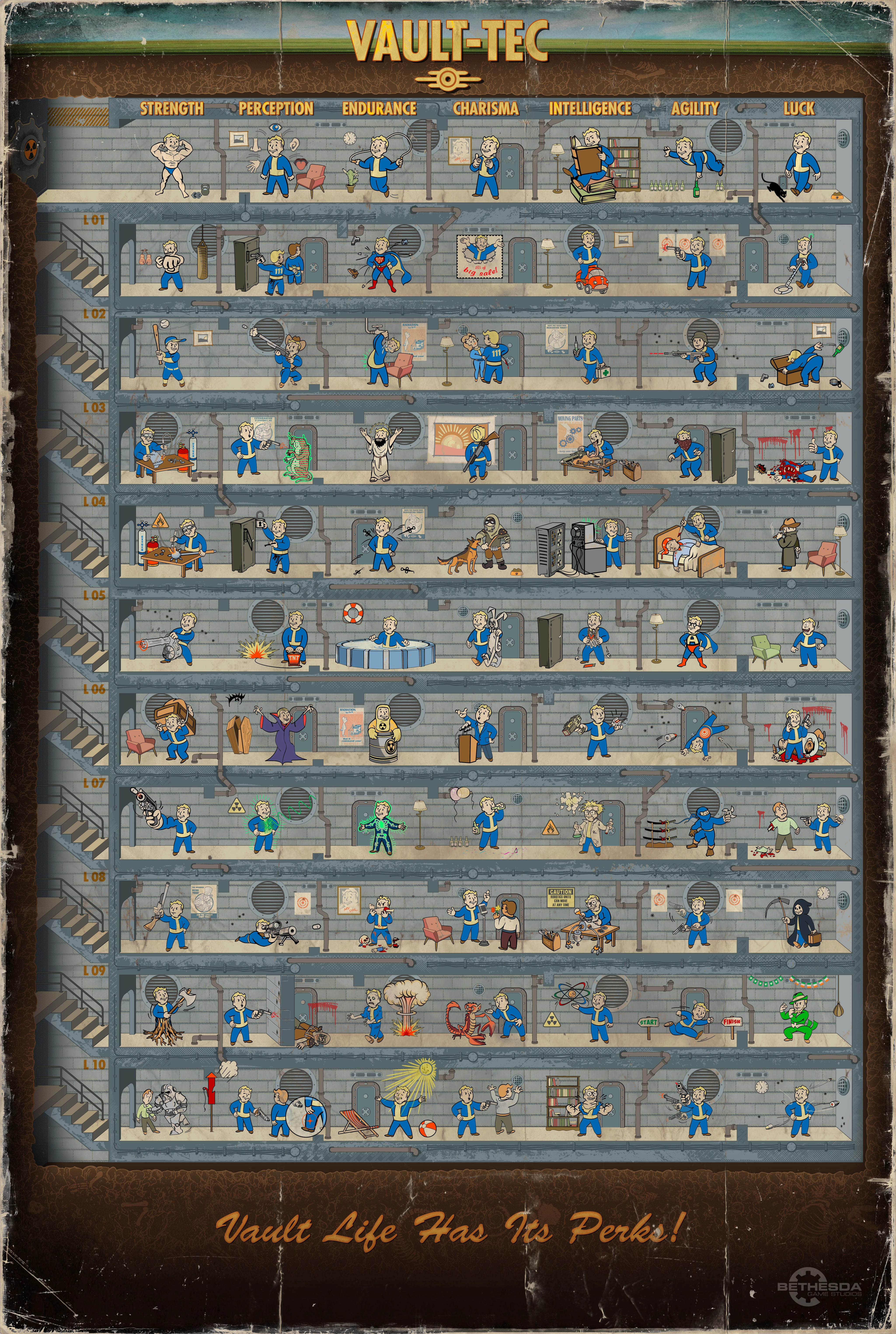
Fallout 4 has been making waves in the gaming community since its release. People have been singing its praises on many fronts, including the town building, crafting, improved character animation, and voice acting. Another area of accolades is in the leveling system. More than just a new and unique way to streamline one the most fundamental RPG mechanics, Fallout 4's character development system represents an evolution in how Bethesda empowers its players.

In order to understand what that means, we must first take a look at its predecessors. Oblivion, being Bethesda’s first open-world RPG with no dice-worlds and fully realized combat, makes a fine starting-point for our purposes. Character progression in Oblivion was unique compared to most other RPGs of the time. When the player creates their character, they select 7 of the game's 21 total skills, which become their major skills. Skills increase as they get used (ex. the Swords skill will go up the more the player uses bladed weapons). After increasing their major skills enough times, the player can level up by sleeping in a bed.
Then, they can choose three stats to increase. Stats, like skills, are measured from 1 to 100, and can increase in increments of +1 to +5. The exact increment depends on how many skills that use the statistic were increased since the last level-up. Swords, as an example, are governed by Strength. By increasing the Swords skill, the player is increasing the amount that Strength will be raised if they choose to increase Strength when they level up.
Now, if you haven't played Oblivion before reading that explanation, that might sound more like legal-ese than the way characters progress in an RPG. There is a very good reason for that. A common complaint about Oblivion, in hindsight, is that this system was overly-complicated. In order to make a decent character, one had to be extremely careful about what skills they trained and when, lest they only get small stat increases. The fact that enemies scale to the player character's level, and that every stat bonus they receive is always +5, gravely exacerbates this problem. Their equipment also grows stronger, to the point where no-name bandits will accost players for 5 gold while wearing highly protective, expertly-crafted armor worth thousands.
On top of that, the enemies dotting the open-world would be replaced by stronger monsters with more powerful skills as the player grew stronger. When starting the game, players are often accosted by wolves and other forest animals. While annoying, these creatures are more of a minor nuisance than anything else. After getting to about level 20 or so, those woodland beasts are exchanged for Minotaurs, which are significantly stronger, faster, and more relentless. Later, even more ruthless Minotaur Lords take their place. As a result, it’s not just that leveling up leaves players with even lower stats than their foes. Those same foes are also being thrown to the wayside so that even more terrifying enemies can litter the field. This problem is so bad that not only are there detailed guides for how to level, but some of them even advocate not leveling up at all as a reasonable solution. After all, unless players are willing to meticulously study and train specific skills in particular orders, leveling up will almost leave them in a worse position.
Despite its problems, Oblivion did serve a purpose. It brought skill-based, real-time to the open-world format, doing away with the invisible dice-rolls of its predecessor Morrowind. The radiant-AI that gave all NPCs set schedules also breathed life to the world (if you ignore the absolutely hideous faces and voice-acting). It wasn’t stellar, but it’s a base. Crucially, it is a base that can be modified and built-upon to create something significantly better.

Using their now-established open-world format, they were going to bring Fallout to modern audiences with Fallout 3. With a new property comes new progression systems. Though similar to Oblivion, Fallout 3 had a more standard leveling system. Like Bethesda's previous game, characters’ abilities were quantified by a combination of individual stats and skills. However, instead of building up their stats as they developed, players chose them at the start of the game, and mostly stuck with them. As they adventured, their character would gain experience and eventually level up. Of course, that is when the player spent points to increase their skills. More importantly, they selected a perk. Though skills go a long way towards determining what one can do, they are only half of the equation. The perks also go a long way in effectively defining a Fallout 3 character. Each one comes with a powerful benefit, from increased stats or skills to stronger critical hits and even new dialogue options to take advantage of. These passive benefits, combined with skills and stats, give a holistic, yet easy to comprehend, view of a character’s abilities.
There were obvious advantages that the Fallout 3 system had over Oblivion's. Firstly, it eliminated the need for meta-gaming that came from Oblivion. Stats were basically determined at the very start of the game, and there was no need to train skills individually since the player can allocate skill points at level up. This meant that players didn't feel pressure to modify their playstyle in order to stay ahead of the enemies. Maximizing a character's performance by researching and planning a build was purely optional, instead of being damn-near required to keep up.
More importantly, this simplified the process of character development when compared to Oblivion. Players gain experience, level up, then acquire skill points and a perk before beginning the process all over again. Though one might expect that adding the variables of perks and perk requirements would further complicated the system, the fact the progression is so transparent and plain compared to Oblivion makes it easier to understand what is going on. By glancing at any given character's skills and perks, it is simple to intuit what kind of character they are, and how they are likely to develop in the future.
The problem of enemies scaling out of control was also corrected in two ways. First, all characters use the same number of stat points, which are by and large locked in from the very beginning of the game. Furthermore, the number of skill points both players and enemies acquire on level up are based on the Intelligence stat, and nothing else. In this way, the enemies’ skills increase at roughly the same rate as the player’s skills, give or take a few points difference in Intelligence. Given that players are often continually augmenting themselves with new perks and equipment, this gives a total net benefit when leveling up, even if they don’t choose an “optimal” build.
The other, less obvious measure Bethesda took when level-scaling is to control how it occurs in the game world. In general, the world scales with the player as one would expect. As the player grows stronger, so too do enemies through the wasteland. This changes slightly when new locations are discovered. By finding a new place to explore, the enemies in and around that area get locked to whatever level the player was at the time.
Immediately after leaving the vault, many players, for a number of reasons, don’t follow the road to Megaton and instead head to the nearby Springvale School. As a “dungeon”, for lack of a better term, Springvale is filled with raiders. By finding it this early on, players will lock the enemies there to level 2 or 3. At this point, a large subset of these players will realize their mistake and run away. After completing quests and getting a little stronger, to around level 5 or so, they may desire to go back to Springvale to extract bloody revenge on the raiders that previously humiliated them. Although the world has scaled to level 5 in the meantime, to match the player, Springvale has not. It was previously locked to level 2, where it remains.
In Oblivion, players could level up a similar way that the above player could in Fallout 3. However, if they did, and returned to a dungeon this same way, they would likely find that it grew harder due to a combination of the level-scaling and enemies acquiring stronger gear. By locking-in a location’s level when it’s discovered, Fallout 3 makes it possible for a player to realize they are outnumbered and out-gunned, then take steps to get stronger and try again, that they may succeed where they once failed. This system worked so well that Skyrim and Fallout 4 would continue to use it in the future.
Bethesda learned their lesson when developing Fallout 3. By building off the foundation of Oblivion, working in some of the design principles of early Fallout games, and mixing in their own observations from the reception of Oblivion, they unknowingly began to embark on a journey of streamlining a simplifying RPG mechanics.

Later, when they returned to their iconic Elder Scrolls series with Skyrim, they continued this journey by overhauling the way characters developed in Oblivion. Players still need to use a skill in order to increase it. However, these skills are no longer governed by stats. In fact, stats aside from Health, Mana, and Stamina are gone. Whenever the player improves one of their skills, they gain experience which goes toward leveling up. Advancing a level allows the player to increase Health, Mana, or Stamina and gain a point which can be spent on a perk.
Yes. Inspired by their experience developing Fallout 3, Bethesda added perks to Skyrim. Attached to each skill is a perk tree, which lists each perk that falls under that skill, and the prerequisite perks and the minimum skill requirements to take the next rank in each one. Each individual perk costs a single point. Players can purchase any perk that they meet the preconditions for, but may also choose to save up their perk points if there is nothing they wish to acquire.
This is important, because it solves a problem that cropped up in Fallout 3. When the player goes up in level in Fallout 3, players are forced to take the skill increases and perk immediately. Occasionally, players in Fallout 3 find that they do not want any of the perks available to them. However, they are still forced to choose one of them to apply to their character. Since skills are trained with repeated use in Skyrim, the odds of this happening are significantly greater. By allowing players to stock up perk points, this problem is deftly avoided.
Yet despite how simple the system is, there was a noticeable drawback. Skills that had no perks invested into their skill trees were practically useless, no matter how much they were trained. I very clearly remember a character that I had played in Skyrim that bests demonstrates this point. By utilizing an exploit, I was able to quickly raise each of his skills to 100. However, I had chosen to focus his perks in Stealth, One-Handed, and Illusion above all else. When I tried to use Destruction magic, despite having a skill rating of 100, the effects of those spells were so minimal, and their Mana costs so high, I might as well have been meekly shoving my enemies for all the damage I was doing. This is because I had not invested in Destruction perks which increase damage and decrease Mana costs. Though the skill ratings did have a slight effect, they were absolutely worthless without perks.
But that on its own isn’t the problem. When I tried using Destruction-magic with that character, it was really more of an experiment, to see how well my supposed “master-wizard” could actually cast without perks. The problem here is that this system asks, especially later in the game, for players to use skills that they wouldn’t otherwise want to use, in order to acquire points to spend on perks in skills they do want to use. I didn’t raise my characters stats to 100 in order to become a god in a mortal vessel. I did it so that I could get the perk points needed to be a better dagger-wielding, illusionist thief. Without the perks afforded by raising these skills, and thus my character’s level, it’s harder to justify taking perks that aren’t core to my character, but are otherwise useful, like Smithing and Enchanting. Investing in them would eat away at perks I can use on my most useful skills.

This might explain the approach taken in Fallout 4. Like Skyrim before it, Fallout 4 attempts to simplify and streamline the leveling process. Rather than go the same direction Skyrim took, Fallout 4 used a different technique more suited to the trappings of the franchise. Instead of removing stats and using skills/perks to determine what a character can do, Fallout 4 opted to remove skills, and use only stats and perks.
At the start of the game, the player is given a set total of points that they can apply to their 7 base stats. These stats determine how much health the player has, their maximum carry weight, their ability to make critical hits, etc, as they did in Fallout 3. Experience, as is also the case in the previous Fallout, is earned by exploring the world and doing what comes naturally. And, as Skyrim players would be familiar with, a point is gained on level up. This point can be spent in several ways: The player can choose to take a new perk or advance a rank in one they already have (assuming the meet the requirements) OR increase one of their base stats by a single point.
Perks also function somewhat differently to accommodate this new system. Each perk corresponds to a prerequisite rank in one of the base stats, without which one cannot take them. Strong Back, as an example, is a perk which raises the player's maximum carry weight. It is the Rank 5 Strength perk, and cannot be taken unless the character in question already has 5 points in Strength. Every perk also has multiple ranks, which provide even bigger bonuses, and these are gated off by the current level of the player character. Rank 2 of Strong Back, to continue our example, increases the benefit of Rank 1 and can only to taken once the player is level 10 or higher.
Even more than in Skyrim, this means that any given player's build is closely tied to what perks they have. By looking at what perks one has taken, it is easy to tell what kind of playstyle they have and/or are going for. The character I played has 5 Ranks each in Rifleman and Sneak, along with 3 Ranks in Sniper, Better Criticals, and Grim Reaper's Sprint and 2 Ranks in Action Boy and Ninja. Someone who has never played Fallout 4 has no idea what any of this means. To one who has played Fallout 4, and even to some who have only placed Fallout 3 or New Vegas, this tells them that I like to abuse VATS to get tons of Sneak Attacks and Critical Hits from a distance using scoped, non-automatic rifles. It also gives a rough idea of what stats I'd need to have in order to acquire all of these perks, since each one has a minimum requirement.
It also solves the problem that Skyrim had where skills and perks weren’t always in alignment. Since skills don’t exist, the “master-wizard” problem I outlined earlier from Skyrim is no longer an issue. As a result, the player character’s abilities are more accurately reflected by their stats and perk ratings than their skills in Skyrim. Perks are also dependent on having a minimum stat rating before they can be taken, increasing the likelihood that stats will correlate with the perks acquired. This all results in a cohesiveness of character absent from the higher-level Skyrim characters.
But despite that, there is still some noticeable room for improvement. Even if the concept behind the perk trees is extremely simple, Bethesda didn't give much in the way of tutorial for how to use it. If one didn't follow the pre-release materials that explained how these systems worked, as I had, they could easily be forgiven for not understanding the system. By looking at the in-game perk chart, it is easy to see why so many assume that they need to get a given stat's perks in order, from top to bottom. The chart makes it seem like such linear progression is necessary. Because of this, it's possible to put points in perks one does not want or need not knowing that they can easily bypass them to get the perks they want if they have high enough stats. The combination of the graphic designer and the lack of tutorials conspire against the player.
The another primary issue is that leveling-up doesn’t feel as meaningful as it did in previous Bethesda games. The only thing players gain at level-up is the perk point, and a few extra hit points. To compensate for this small reward, level-ups are much more frequent than in previous games.
In Fallout 3 and Skyrim, leveling up felt like a special event. After enduring many tough trials, Fallout 3 characters were rewarded with the chance to strengthen their skills and obtain a unique bonus for themselves. And although Skryim also gave only a perk point and some bonus health/mana/stamina on level-up, the skill training required to grow stronger was a reward itself. Not only were the rewards more substantial, but they came infrequently that the player could eagerly look forward to the next time they built up enough experience to see that screen just one more time. Perks, and thus levels, have to arrive at increasingly frequency in Fallout 4, depriving players of their dopamine fix.


Fallout 4's level system isn't perfect, but it is another step in a long journey that Bethesda started in 2006 with Oblivion. For better or worse, Bethesda has been focusing on refining and streamlining the mechanics in their games, the leveling system being only one prominent example. Even if there are some flaws, one must appreciate the desire to experiment and improve these systems. Once people have had enough time to properly digest Fallout 4, I have no doubt that we will discover flaws that have been otherwise overlooked at the time of writing. It will be interesting to see what Bethesda does in response to these criticisms, and which direction they’ll along this road to refining their mechanics.

Saturday, October 31, 2015

#99: When Will You Stop Playing Undertale?


(Spoiler Alert: This article discusses important plot points and twists in Undertale.)
I've begun to notice a new trend in video games, especially in RPGs. The current generation of game designers grew up on the games that built the genre, like Final Fantasy and Ultima. When they entered the industry, they took with them an appreciation and understanding of the tropes created and used by these RPGs. Manifesting itself within their works, this understanding allows them to make games that are more self-aware. Some games are content to just lampshade and acknowledge those very tropes, laughing them off as an in-joke between the designers and the players. Others exist to show the potential implications behind them; to demonstrate the potential horrors of a world where those tropes we take for granted in games are reality. Undertale is one such game, and it has a damning, if not subtle, message to deliver to its player base.

Created by Toby Fox, Undertale is an RPG, inspired by the likes of Earthbound. What separates it from other small-budget, independently-developed RPGs is that it bills itself as a “friendly” game. Though the player encounters random enemies while exploring, they never have to kill any one of them. This isn't necessary new, as Shin Megami Tensei has frequently allowed players to converse with and recruit demons. However, Undertale takes this basic concept to a logical extreme. Every enemy, even the bosses, can be dealt with without dealing a lethal blow. This is the way in which Undertale helps set the stage for its moral lessons.

In most RPGs, players fight and kill hundreds, if not thousands, of creatures over the course of the game, with little regard for their lives. To the players, and to the protagonists, they are nothing more than speed bumps in the road to their objective. Undertale asks what kind of person is this protagonist, and what kind of effect would that person have on those around him. If the player chooses to murder every enemy they encounter, they'll begin to see the effects quickly. Towns and areas will become depopulated, devoid of life. Shopkeepers will abandon their stores and their stock before the protagonist arrives in an effort to escape the carnage with their lives intact. City guards and brave heroes will attempt to stop them in their tracks.
In other words, the player who murders every enemy they encounter, who acts like any other RPG protagonist, is a complete genocidal-maniac. To rack up such a high kill count and slaughter so many, they would have to be. By implication, Undertale is saying that this would be true of the lead protagonists of most RPGs and the company those “heroes” keep. Simply by adventuring and fighting against all these creatures, they are complicit in mass homicide. Even if the opponents aren't sapient, the kind of damage that would ensue on the ecosystem would make life nearly unsustainable. Undertale claims that although we see them as heroes from our viewpoint, the damage they do would only make a bad situation worse. As players, we take for granted that we are in the right, or at least trying to do good. Undertale questions the wisdom of saying that we are morally correct just because we are playing as the protagonist.

But that is not the only RPG mechanic Undertale challenges by exploring its implications. The idea of replaying games with multiple endings, and seeing “all that a game has to offer” also comes into close scrutiny. At any point before beating the game, the player is allowed to start over from the beginning. However, characters in the story will remember and comment on what choices they made in their previous playthrough. Most will discover this in the same way I did. The first boss in the game is your maternal figure, Toriel, who guides you and protects you at the start. In my first run, I had not realized that the trick to saving her is to constantly use the Spare option until she gives up, and my ignorance killed her. Regretting my actions, I consulted the wiki and learned how to keep her from dying. I reset my playthrough and used the non-lethal method to win the boss fight. Immediately afterward, the next character I spoke to mocked me for “growing a conscience” and redoing that section of the game to spare her. For going back to see the alternate outcome, I was chastised by the very game I was playing.
Continuing along this theme, should the player get the Pacifist ending, for never killing a single thing and completing all the prerequisite side content, they are given the option to perform a True Reset, essentially erasing not only the current save, but any record that previous runs ever occurred, returning the game to a factory-standard. When the player launches the game after unlocking this option, one character appears on screen begging them not to use it. By doing so, they claim that the player would be erasing the happy endings that the cast had earned throughout the game, a fate more cruel than anything else that could happen to them.
In the Genocide run of the game, the player has a conversation with the only other major villain aside from themselves. During this discussion, this person praises the player for their willingness to give in to their murderous instincts and show no mercy. Then, something strange happens. He begins to talk about the people who “want to go through with this, but don't have the guts to do it themselves.” Taunting them, he claims that there are “Probably watching a video of this right now.” (A fact that I learned, fittingly enough, by watching someone else's Let's Play of a Genocide run.)
All of this boils down to Undertale's one, overarching message: Even though the content exists in the game's files, it isn’t something the audience necessarily needs to see. The game is blatant in the way that it encourages its players to save everyone and avoiding making even a single kill. That said, the option to ignore its warnings and embark on a bloody campaign exists. It's there, but it is something that players absolutely have to experience this content? Do they have to sacrifice the good times they had with the friends they made along the way in the service of seeing every bit of content on offer? Are all those lives the player took worth the Genocide ending? And if they aren't, is it even worth the time it takes to look up a YouTube video showing the differences? Undertale ponders these questions and answers with a definitive “no”. All these choices exist, but in reality the game considers the first playthrough to be the only thing worth the player’s time. Anything else being needless fluff padding out your time with it.


Though Undertale lacks a subtlety regarding the way it challenges these tropes used in the vast majority of RPG game design, there is no denying that is does challenge them. Lately, there have been more and more games that deconstruct and analyze their own medium. Given that the generation that grew up on gaming has finally matured to the point where it can enter the industry proper, I expect to see more of these deconstructions as time goes on. Like Undertale, their creators have something to say about the games they played growing up, and now they have the means and opportunity to express those thoughts.

Sunday, August 16, 2015

#96: Final Fantasy Type-0: Experience of the Sidelines


I've played a great many RPGs throughout the years. In that time, I have seen many design decisions constantly repeated and reiterated across various different games. Often it makes sense to reuse these tropes. For example, leveling up is such a core concept in RPGs that it would be strange to have no form of character development. However, some of these same choices come back for seemingly no reason whatsoever.
Recently, I beat Final Fantasy Type-0 HD, victim to one of the latter design choices. Taking place in a steampunk/fantasy setting, Type-0 is a war story following the exploits of Class Zero, a group of cadets at the military academy in one of the four great nations in the world. There are 14 members of Class Zero, all playable characters in the game. The player can have, at most, 3 of the classmates deployed at the same time, with other members on standby. When an enemy is defeated, only the 3 deployed classmates gain experience, while every other character gets nothing. And while Final Fantasy Type-0 is hardly the first RPG to make this choice, it’s the one I can best use to explain the problems inherent to it.

Depriving non-participants of experience discourages players from experimenting with their party formation and character selection. When Final Fantasy Type-0 first introduces the player to the full cast, it makes the recommendation to "try to level every character evenly". This, as is the case with most games where members on standby don't gain experience, is a terrible idea. Following this advice will have one of two possible outcomes: Either the party will be so under-leveled that playing through main story missions is an exercise in frustration, or so much time will be spent grinding for experience that the player will completely forget the main story. Raising a character by a single-level takes a great many battles. With 14 playable characters, bringing them up to each missions recommended level would take several hours of tedious grinding. At the same time, missions at a much higher level pit the player against enemies that can and will annihilate a single character in one or two attacks. For this reason, most players will ultimately decided on 3 or 4 characters that they will focus their experience on, and largely ignore the rest of the them.
Part of the draw of a large pool of playable characters is that there is a variety in the archetypes and playstyles. Under the restriction that party members only level up when they actively partake in battle, this variety is stifled by practicality. For instance: there might be circumstances where it would make more sense to use a long-range party of King the duel-pistol wielder, Cater the magic-gunslinger, and Trey the archer, like when a mission is packed with flying enemies out of melee range. However, most people will likely only have one of them leveled enough to use in that mission. While it may make more sense to use that particular party against ranged enemies, it makes no sense to use it in any other circumstance.
Since it's only sensible to train up about 4 people, most players will have a strong melee-character, a good ranged character, and a support, with a possible backup character in the event one of the first three dies. Any thought of changing up the party to suit a new situation, or experimenting to find a formation that may work better, is thrown to the wayside in favor of sticking with the old and familiar.

On top of that, games with sufficiently large casts nearly always have scenes where the party has to divide itself into multiple groups, and Final Fantasy Type-0 is no exception. Several missions have the player form 2 groups of three cadets each. Since the odds are that most players will only have enough characters leveled up for one full battle party, this section is significantly worse than it should be. Practicality, it ensures that one team will be vastly inferior to the other, or that both teams will have one under-leveled character dragging them down. In either case, battle ability is severely reduced because the player has done exactly what the game's systems have incentivized them to do.
In my playthrough, during the first of these missions, both of the parties had two characters that were Level 30, and one trailing far behind at Level 15. Unsurprisingly, the weak one in each party did hardly any damage, spending most of the mission as a corpse. With two characters left to pick up the slack of a three-person job, I didn't have as much fun with these missions as did with the others in the game. I had to restart this mission several times because, with the addition of my undue handicap, the enemies were just strong enough that my two level 30s in one team taking much more damage any dying more than they had in other missions. At one point, I even had to give up, go into a previous save, and rethink who I sent with which team. Needless to say, I was fairly unhappy with the game for crippling me like that.


Even though it’s extremely clear that this one concept hurts the games that use it, it is unlikely to get phased out anytime soon. As a genre, RPGs are soaked in tradition, making it difficult to weed out overused design cliches. Even worse, this is one that appears frequently, even in many of the greats like Persona 4 and Valkyrie Profile. Knowing this, I still think it's healthy to evaluate these game design tropes to see if they're still worth maintaining. Though it's common for the reserve party to not gain experience, this trope does more harm than good.

Friday, September 12, 2014

#75: Are RPGs Even Allowed to Have "Good" Combat?

As I said in last week's post, my free time has been spent playing old PlayStation 2 ATLUS RPGs. Having beaten Devil Summoner, I have been making progress through Digital Devil Saga. However, this is not an Impressions piece on that game as it will take some time to finish, now that college classes are taking up my time again. Worry not, my friends, because playing through this game has given me an interesting idea for a subject of an article. One idea has been clawing at the back of my mind for some time now. This idea is as follows: “Are RPGs even allowed to have 'good' combat?”

This might at first seem like a weird question, but hear me out. Though this is not always the case, most gamers, on some level, associate RPGs with longer playtimes than would typically expected of other games. These lengths usually exceed 30 hours, and it is not uncommon for them to go up to 50 hours or greater. In order to facilitate player engagement for the entire length of one of these games, combat has to fill a very particular niche. Should the fighting be too busy, then players will become fatigued from having to repeatedly consume mental stamina to stay on top. This will result in them either taking long breaks between sessions, or being incapable of playing for more than an hour or so at a time before they need to call it quits.
Kingdoms of Amalur served as a decent example of that. At a minimum, a typical playthrough will take about 50 hours to clear. In order to keep the player's attention throughout this length, the development team went out of their way to try to make the best combat they could. In order to have good fighting in the game, they made players have to watch all of their enemies in order to know when to dodge attacks and counter with their own. It requires observation of the enemy, their patterns, and the properties of their attacks. Further, a sense of timing and, to a lesser extent, rhythm is needed to capitalize on openings and avoid making them yourself. There is quite a lot going on, even in beginning fights. While the game does have a leveling mechanic, so fighting against enemies of lower/higher level will make it easier/harder, the game does a fairly good job of keeping the player at just the right level to get a decent challenge going throughout the experience.
Unfortunately, this style of combat has drawbacks that can only be seen when placed in an RPG and extended for long lengths of time. First, the player's attack properties are always in flux. Different weapon types possess different attack animations, so equipping a new weapon can completely throw off the sense of timing and result in unnecessary grief in a fight. Even when the same type of weapon is equipped, each one has their own properties. This results in dealing different damage and having different ranges. It might not sound like much, but that can have a dramatic impact on overall strategy. While some of this is necessary in order to keep scenarios new and interesting, the nature of the game makes this so regular that players rarely have time to get used to old tactics before new ones are needed. Other issues crop up as well. For example, the mental strain required to keep all of these factors in mind is draining. It results in a feeling of general exhaustion when playing the game. Such feeling are exacerbated when the typical RPG trappings of inventory management and character development are included. The constant need to fiddle with equipment and build setups, while partaking in very active engagements, can reduce even the strongest willpower to nothing.

On the other hand, RPGs cannot make the combat too boring. This opposite problem is what many people who shy away from RPGs typically associate with them. If the game does not make its combat engaging enough, players will still not play it for very long, for surprisingly similar reasons. A boring, monotonous slog can often be exactly as draining as overengagement. As a result, a game that does not bring a proper level of engagement to the forefront will tire out users and get them to stop playing.
Final Fantasy XII had this problem in spades. The combat system, seemingly inspired by MMOs, took place in real-time, with attacks taking a period of time to perform depending on the user's speed stat. The game also had a system called Gambits. Basically, the game allowed players to control the player AI's algorithm, as determined by a series of if-then statements. As a result of this system, most of the game was automated. Tasks like healing, buffing/debuffing, and exploiting enemy weaknesses could simply by handed off to the AI. Theoretically, this could be free the player up to focus more on task at hand, dealing with fighting on the macro level as opposed to the micro level. In execution, most fights could be completed without a single input of the part of the player. All the player really had to do was make sure the party was moving throughout the dungeon, completing the puzzles and getting to the next cutscene. As a result, it gets boring quickly, and finishing the game can be considered a bit of a chore.

In order to keep players interested throughout the length of the game, the combat needs to be just challenging enough so that it draws and holds the player's attention without taxing them too heavily. Heading too far in either direction will just tire the player out, either through exhaustion or boredom. While the player needs to be “going through the motions” to a degree, some variety must come from somewhere in order to keep interest, while still maintaining a structure to the combat. This is ultimately where the crux of my argument comes from. Can this balance really be seen as “good” combat? Is it “fun” in the traditional sense? Or is it merely good enough to hold a typical player's attention throughout the course of the game, without honestly being that entertaining in its own right?


I do not honestly have that answer. As much as I mulled over this point and even after playing countless games in the genre, I cannot reach a satisfactory conclusion. Thus, I would like to hear your input on the matter. Should any of you have an opinion on this subject that you wish to share, please feel free to contact me, either in the comments below or on social media. I look forward to hearing from all of you.