Showing posts with label Fallout 3. Show all posts

Sunday, December 13, 2015

#101: The Evolution of Bethesda Leveling Systems


Fallout 4 has been making waves in the gaming community since its release. People have been singing its praises on many fronts, including the town building, crafting, improved character animation, and voice acting. Another area of accolades is in the leveling system. More than just a new and unique way to streamline one the most fundamental RPG mechanics, Fallout 4's character development system represents an evolution in how Bethesda empowers its players.

In order to understand what that means, we must first take a look at its predecessors. Oblivion, being Bethesda’s first open-world RPG with no dice-worlds and fully realized combat, makes a fine starting-point for our purposes. Character progression in Oblivion was unique compared to most other RPGs of the time. When the player creates their character, they select 7 of the game's 21 total skills, which become their major skills. Skills increase as they get used (ex. the Swords skill will go up the more the player uses bladed weapons). After increasing their major skills enough times, the player can level up by sleeping in a bed.
Then, they can choose three stats to increase. Stats, like skills, are measured from 1 to 100, and can increase in increments of +1 to +5. The exact increment depends on how many skills that use the statistic were increased since the last level-up. Swords, as an example, are governed by Strength. By increasing the Swords skill, the player is increasing the amount that Strength will be raised if they choose to increase Strength when they level up.
Now, if you haven't played Oblivion before reading that explanation, that might sound more like legal-ese than the way characters progress in an RPG. There is a very good reason for that. A common complaint about Oblivion, in hindsight, is that this system was overly-complicated. In order to make a decent character, one had to be extremely careful about what skills they trained and when, lest they only get small stat increases. The fact that enemies scale to the player character's level, and that every stat bonus they receive is always +5, gravely exacerbates this problem. Their equipment also grows stronger, to the point where no-name bandits will accost players for 5 gold while wearing highly protective, expertly-crafted armor worth thousands.
On top of that, the enemies dotting the open-world would be replaced by stronger monsters with more powerful skills as the player grew stronger. When starting the game, players are often accosted by wolves and other forest animals. While annoying, these creatures are more of a minor nuisance than anything else. After getting to about level 20 or so, those woodland beasts are exchanged for Minotaurs, which are significantly stronger, faster, and more relentless. Later, even more ruthless Minotaur Lords take their place. As a result, it’s not just that leveling up leaves players with even lower stats than their foes. Those same foes are also being thrown to the wayside so that even more terrifying enemies can litter the field. This problem is so bad that not only are there detailed guides for how to level, but some of them even advocate not leveling up at all as a reasonable solution. After all, unless players are willing to meticulously study and train specific skills in particular orders, leveling up will almost leave them in a worse position.
Despite its problems, Oblivion did serve a purpose. It brought skill-based, real-time to the open-world format, doing away with the invisible dice-rolls of its predecessor Morrowind. The radiant-AI that gave all NPCs set schedules also breathed life to the world (if you ignore the absolutely hideous faces and voice-acting). It wasn’t stellar, but it’s a base. Crucially, it is a base that can be modified and built-upon to create something significantly better.

Using their now-established open-world format, they were going to bring Fallout to modern audiences with Fallout 3. With a new property comes new progression systems. Though similar to Oblivion, Fallout 3 had a more standard leveling system. Like Bethesda's previous game, characters’ abilities were quantified by a combination of individual stats and skills. However, instead of building up their stats as they developed, players chose them at the start of the game, and mostly stuck with them. As they adventured, their character would gain experience and eventually level up. Of course, that is when the player spent points to increase their skills. More importantly, they selected a perk. Though skills go a long way towards determining what one can do, they are only half of the equation. The perks also go a long way in effectively defining a Fallout 3 character. Each one comes with a powerful benefit, from increased stats or skills to stronger critical hits and even new dialogue options to take advantage of. These passive benefits, combined with skills and stats, give a holistic, yet easy to comprehend, view of a character’s abilities.
There were obvious advantages that the Fallout 3 system had over Oblivion's. Firstly, it eliminated the need for meta-gaming that came from Oblivion. Stats were basically determined at the very start of the game, and there was no need to train skills individually since the player can allocate skill points at level up. This meant that players didn't feel pressure to modify their playstyle in order to stay ahead of the enemies. Maximizing a character's performance by researching and planning a build was purely optional, instead of being damn-near required to keep up.
More importantly, this simplified the process of character development when compared to Oblivion. Players gain experience, level up, then acquire skill points and a perk before beginning the process all over again. Though one might expect that adding the variables of perks and perk requirements would further complicated the system, the fact the progression is so transparent and plain compared to Oblivion makes it easier to understand what is going on. By glancing at any given character's skills and perks, it is simple to intuit what kind of character they are, and how they are likely to develop in the future.
The problem of enemies scaling out of control was also corrected in two ways. First, all characters use the same number of stat points, which are by and large locked in from the very beginning of the game. Furthermore, the number of skill points both players and enemies acquire on level up are based on the Intelligence stat, and nothing else. In this way, the enemies’ skills increase at roughly the same rate as the player’s skills, give or take a few points difference in Intelligence. Given that players are often continually augmenting themselves with new perks and equipment, this gives a total net benefit when leveling up, even if they don’t choose an “optimal” build.
The other, less obvious measure Bethesda took when level-scaling is to control how it occurs in the game world. In general, the world scales with the player as one would expect. As the player grows stronger, so too do enemies through the wasteland. This changes slightly when new locations are discovered. By finding a new place to explore, the enemies in and around that area get locked to whatever level the player was at the time.
Immediately after leaving the vault, many players, for a number of reasons, don’t follow the road to Megaton and instead head to the nearby Springvale School. As a “dungeon”, for lack of a better term, Springvale is filled with raiders. By finding it this early on, players will lock the enemies there to level 2 or 3. At this point, a large subset of these players will realize their mistake and run away. After completing quests and getting a little stronger, to around level 5 or so, they may desire to go back to Springvale to extract bloody revenge on the raiders that previously humiliated them. Although the world has scaled to level 5 in the meantime, to match the player, Springvale has not. It was previously locked to level 2, where it remains.
In Oblivion, players could level up a similar way that the above player could in Fallout 3. However, if they did, and returned to a dungeon this same way, they would likely find that it grew harder due to a combination of the level-scaling and enemies acquiring stronger gear. By locking-in a location’s level when it’s discovered, Fallout 3 makes it possible for a player to realize they are outnumbered and out-gunned, then take steps to get stronger and try again, that they may succeed where they once failed. This system worked so well that Skyrim and Fallout 4 would continue to use it in the future.
Bethesda learned their lesson when developing Fallout 3. By building off the foundation of Oblivion, working in some of the design principles of early Fallout games, and mixing in their own observations from the reception of Oblivion, they unknowingly began to embark on a journey of streamlining a simplifying RPG mechanics.

Later, when they returned to their iconic Elder Scrolls series with Skyrim, they continued this journey by overhauling the way characters developed in Oblivion. Players still need to use a skill in order to increase it. However, these skills are no longer governed by stats. In fact, stats aside from Health, Mana, and Stamina are gone. Whenever the player improves one of their skills, they gain experience which goes toward leveling up. Advancing a level allows the player to increase Health, Mana, or Stamina and gain a point which can be spent on a perk.
Yes. Inspired by their experience developing Fallout 3, Bethesda added perks to Skyrim. Attached to each skill is a perk tree, which lists each perk that falls under that skill, and the prerequisite perks and the minimum skill requirements to take the next rank in each one. Each individual perk costs a single point. Players can purchase any perk that they meet the preconditions for, but may also choose to save up their perk points if there is nothing they wish to acquire.
This is important, because it solves a problem that cropped up in Fallout 3. When the player goes up in level in Fallout 3, players are forced to take the skill increases and perk immediately. Occasionally, players in Fallout 3 find that they do not want any of the perks available to them. However, they are still forced to choose one of them to apply to their character. Since skills are trained with repeated use in Skyrim, the odds of this happening are significantly greater. By allowing players to stock up perk points, this problem is deftly avoided.
Yet despite how simple the system is, there was a noticeable drawback. Skills that had no perks invested into their skill trees were practically useless, no matter how much they were trained. I very clearly remember a character that I had played in Skyrim that bests demonstrates this point. By utilizing an exploit, I was able to quickly raise each of his skills to 100. However, I had chosen to focus his perks in Stealth, One-Handed, and Illusion above all else. When I tried to use Destruction magic, despite having a skill rating of 100, the effects of those spells were so minimal, and their Mana costs so high, I might as well have been meekly shoving my enemies for all the damage I was doing. This is because I had not invested in Destruction perks which increase damage and decrease Mana costs. Though the skill ratings did have a slight effect, they were absolutely worthless without perks.
But that on its own isn’t the problem. When I tried using Destruction-magic with that character, it was really more of an experiment, to see how well my supposed “master-wizard” could actually cast without perks. The problem here is that this system asks, especially later in the game, for players to use skills that they wouldn’t otherwise want to use, in order to acquire points to spend on perks in skills they do want to use. I didn’t raise my characters stats to 100 in order to become a god in a mortal vessel. I did it so that I could get the perk points needed to be a better dagger-wielding, illusionist thief. Without the perks afforded by raising these skills, and thus my character’s level, it’s harder to justify taking perks that aren’t core to my character, but are otherwise useful, like Smithing and Enchanting. Investing in them would eat away at perks I can use on my most useful skills.

This might explain the approach taken in Fallout 4. Like Skyrim before it, Fallout 4 attempts to simplify and streamline the leveling process. Rather than go the same direction Skyrim took, Fallout 4 used a different technique more suited to the trappings of the franchise. Instead of removing stats and using skills/perks to determine what a character can do, Fallout 4 opted to remove skills, and use only stats and perks.
At the start of the game, the player is given a set total of points that they can apply to their 7 base stats. These stats determine how much health the player has, their maximum carry weight, their ability to make critical hits, etc, as they did in Fallout 3. Experience, as is also the case in the previous Fallout, is earned by exploring the world and doing what comes naturally. And, as Skyrim players would be familiar with, a point is gained on level up. This point can be spent in several ways: The player can choose to take a new perk or advance a rank in one they already have (assuming the meet the requirements) OR increase one of their base stats by a single point.
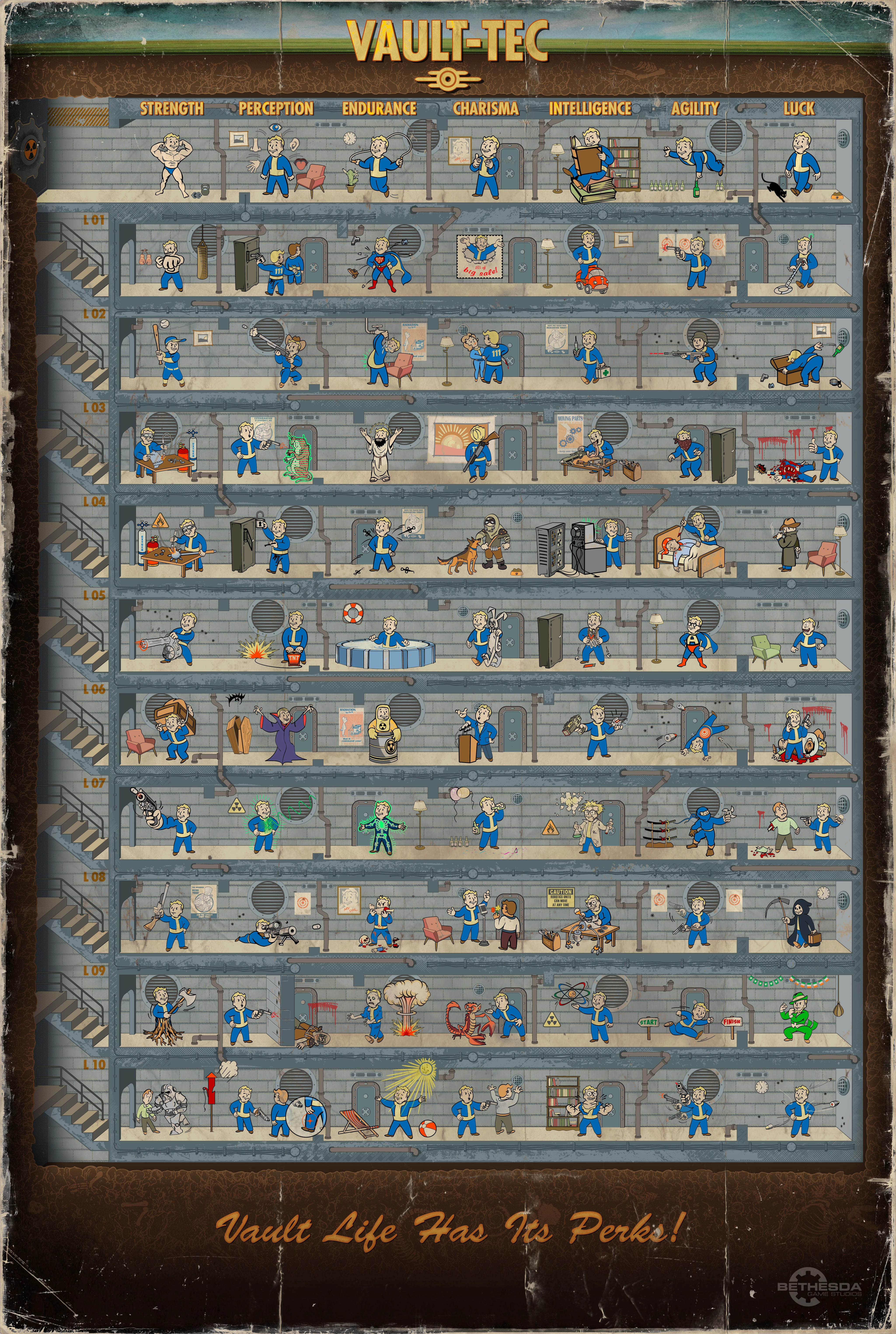
Perks also function somewhat differently to accommodate this new system. Each perk corresponds to a prerequisite rank in one of the base stats, without which one cannot take them. Strong Back, as an example, is a perk which raises the player's maximum carry weight. It is the Rank 5 Strength perk, and cannot be taken unless the character in question already has 5 points in Strength. Every perk also has multiple ranks, which provide even bigger bonuses, and these are gated off by the current level of the player character. Rank 2 of Strong Back, to continue our example, increases the benefit of Rank 1 and can only to taken once the player is level 10 or higher.
Even more than in Skyrim, this means that any given player's build is closely tied to what perks they have. By looking at what perks one has taken, it is easy to tell what kind of playstyle they have and/or are going for. The character I played has 5 Ranks each in Rifleman and Sneak, along with 3 Ranks in Sniper, Better Criticals, and Grim Reaper's Sprint and 2 Ranks in Action Boy and Ninja. Someone who has never played Fallout 4 has no idea what any of this means. To one who has played Fallout 4, and even to some who have only placed Fallout 3 or New Vegas, this tells them that I like to abuse VATS to get tons of Sneak Attacks and Critical Hits from a distance using scoped, non-automatic rifles. It also gives a rough idea of what stats I'd need to have in order to acquire all of these perks, since each one has a minimum requirement.
It also solves the problem that Skyrim had where skills and perks weren’t always in alignment. Since skills don’t exist, the “master-wizard” problem I outlined earlier from Skyrim is no longer an issue. As a result, the player character’s abilities are more accurately reflected by their stats and perk ratings than their skills in Skyrim. Perks are also dependent on having a minimum stat rating before they can be taken, increasing the likelihood that stats will correlate with the perks acquired. This all results in a cohesiveness of character absent from the higher-level Skyrim characters.
But despite that, there is still some noticeable room for improvement. Even if the concept behind the perk trees is extremely simple, Bethesda didn't give much in the way of tutorial for how to use it. If one didn't follow the pre-release materials that explained how these systems worked, as I had, they could easily be forgiven for not understanding the system. By looking at the in-game perk chart, it is easy to see why so many assume that they need to get a given stat's perks in order, from top to bottom. The chart makes it seem like such linear progression is necessary. Because of this, it's possible to put points in perks one does not want or need not knowing that they can easily bypass them to get the perks they want if they have high enough stats. The combination of the graphic designer and the lack of tutorials conspire against the player.
The another primary issue is that leveling-up doesn’t feel as meaningful as it did in previous Bethesda games. The only thing players gain at level-up is the perk point, and a few extra hit points. To compensate for this small reward, level-ups are much more frequent than in previous games.
In Fallout 3 and Skyrim, leveling up felt like a special event. After enduring many tough trials, Fallout 3 characters were rewarded with the chance to strengthen their skills and obtain a unique bonus for themselves. And although Skryim also gave only a perk point and some bonus health/mana/stamina on level-up, the skill training required to grow stronger was a reward itself. Not only were the rewards more substantial, but they came infrequently that the player could eagerly look forward to the next time they built up enough experience to see that screen just one more time. Perks, and thus levels, have to arrive at increasingly frequency in Fallout 4, depriving players of their dopamine fix.


Fallout 4's level system isn't perfect, but it is another step in a long journey that Bethesda started in 2006 with Oblivion. For better or worse, Bethesda has been focusing on refining and streamlining the mechanics in their games, the leveling system being only one prominent example. Even if there are some flaws, one must appreciate the desire to experiment and improve these systems. Once people have had enough time to properly digest Fallout 4, I have no doubt that we will discover flaws that have been otherwise overlooked at the time of writing. It will be interesting to see what Bethesda does in response to these criticisms, and which direction they’ll along this road to refining their mechanics.

Tuesday, July 10, 2012

#29: Fallout 3 vs. Fallout: New Vegas, The Difference of Game Design Philosophy


There are many different people working in this industry. They all bring their own perspectives and biases regarding video games and what make them good. This is no less true for the designers of video games. Each design team and each person on those teams brings different ideas and different viewpoints to the table. This week's article is about how these differences can lead to radically different games. Fortunately for me, there are two games that are perfect for this article as a way to compare/contrast design philosophies. They are very similar, yet fundamentally different due to the teams who created them and the circumstances behind their development. These games are the recent Fallout games: Fallout 3 and Fallout: New Vegas.

I want to start off with a disclaimer: This is not a debate as to which one these games is better. This is just as analysis of different design philosophies resulting in fundamentally different games. These games are ideal for an analysis like this. Both of these games were developed with the same engine and are in the same “Open-World RPG” genre, meaning that they look and play very similarly. New Vegas improved on Fallout 3's mechanics, but did not significantly change them, so they are close enough that it does not impact the comparison to a significant degree. They are part of the same series, which means they are using the same lore and building on the same world. On most levels, these games are the exact same. The only differences between these two games are the result of design decisions, which puts them in the perfect position to compare and contrast on a purely design level.

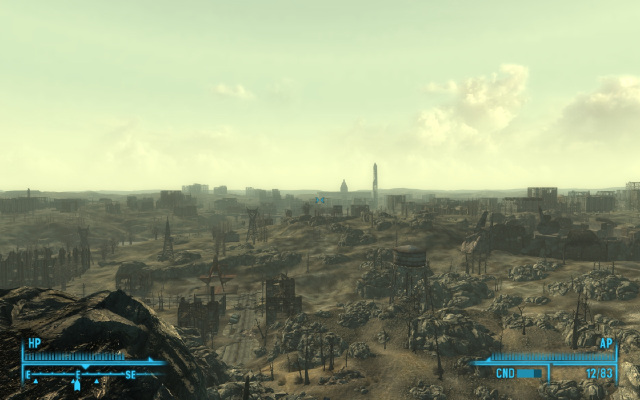
Fallout 3 is made using Bethesda Softworks's standard rulebook for RPG design. They applied the same philosophies that governed the creation of hit titles like Oblivion or Skyrim when developing the third installment of the Fallout franchise. They favor building open sandboxes that the player is free to explore at will, which is reflected in the choices they made. The layout of the Capital Wasteland is wide-open and generally flat terrain, allowing players to see many of the world's set-pieces from a distance and encouraging them to travel around and explore each of them. When the player first exits the vault, he/she gets an amazing view of the nearby town Megaton, a school building to explore, and the image of the DC ruins in the distance, establishing several possible destinations that the player go choose to go to.

Another strength of typical Bethesda design is that they are very good at telling small, self-contained stories within their games through careful design of the environment and the people in them. I have talked about this briefly in the past in a previous article, but it cannot hurt repeat. Bethesda puts enough detail into the places and set-pieces that they all tell their own stories. It is hard to describe this in any way put through example. In the DC ruins, there is a nuclear shelter that takes $0.10 to open. In this shelter there is a male skeleton, a female mannequin, a bottle of wine, and a clothing item called “Sexy Sleepware”. I do not think I have to spell out what all of that means. You can figure the story out without any guidance. Another example comes from a scene I once came across. When exploring the Capital Wasteland, I came across a group of wanders who were selling an item called “Strange Meat”. They claimed that it was some of the best meat in the Wasteland. Those who are familiar with either Fallout 3 or my earlier works know that “Strange Meat” is actually human flesh. Since I knew this, I killed every single one of them and gained good karma for it. I like how Bethesda just leaves details in the game and allows the player to use common sense to infer what happened. It gives the player a motivation to explore and see what else is out there.

The final strength of Bethesda's style is that they are very good at using the RPG mechanics to bolster the spirit of exploration. One of the most noticeable and well-known parts aspects of this is the level scaling mechanic they used in Fallout 3, which most people agree is vastly superior to the one they used in The Elder Scrolls IV: Oblivion. In Fallout 3, every location has a level associated with it. As the player's character level rises, the levels of these locations also rise. However, when a player first visits an area, that area's level is locked, which prevents it from rising any further. The way this works gives the player freedom to explore where ever they want without fear of being completely overwhelmed (with some exceptions).

Another good way they use RPG elements is that they give the player a clear sense of progression and a feeling that they are growing stronger as the adventure goes on. The player gains experience for doing most of the things an adventurer would do like killing enemies, completing quests, hacking terminals, picking locks, etc. As with most RPGs, getting enough experience will cause the player to level up. As Bethesda explained it in the interviews leading up to the release of the game, they wanted every level up to be a special moment that players look forward to. On that count, they succeed. Each level gives the player skill points based on his/her Intelligence stat and a perk. Perks are little bonuses that give the player a diverse and interesting set of advantages. Players will crave experience, hoping to level up and gain skill points and perks and making them want to explore the world even more. Beyond that, the perk system and the skill point system give the player a clear sense of progression. A player can feel the difference a single level in make in the character's stats.

As good at Bethesda style games are in terms of exploration, they do have downsides. For one, while they give a lot of attention to the smaller environmental details, they are not very good at looking at the big picture in terms of environment. For example, in the whole Capital Wasteland, there is no farm land anywhere. The game explains that most of the food is from two-hundred years ago and scavenged from the DC ruins. This makes no sense. Food that old, even if it was stuffed with preservatives, could not possibly be edible. They have animals and creatures around that drop meat when killed, but there is no explanation as to how they live in an area with no vegetation. Water is also a huge problem. According to the game, since DC was hit the hardest in the nuclear apocalypse, all of the water has a lot of radiation and is somewhat toxic to humans. There is a explanation for this since a major plot point in the game is providing fresh water to the Wasteland, but it still poses a significant problem. With the fact that basic resources cannot be found overlooked/omitted, the Capital Wasteland realistically could not possibly sustain life. There is no notable way to provide food or water to the people of the Wastes. Another crucial environmental detail that was overlooked was in a place called Tenpenny Tower. In this tower, located in the Southern half of the Capital Wasteland, there is a group of people who live in the tap of luxury... only there is no reason for them to be rich. As far as I am aware, the residents of Tenpenny do not engage in any sort of trade and have no real way to profit. They are only rich simply because the game needed stereotypical rich people to serve as evil-aligned characters for a few side quests. All three of the details here are crucial details about the world that Bethesda failed to take into account, either because of constraints or through focusing too much on the exploration aspects of the game, when creating the DC area in Fallout 3.

The other problem with Bethesda design is that while they excel at the use of environmental storytelling, but the storytelling of their main plots are not up to the same quality. Fallout 3 in particular had several moments in the story where either what was happening or what the player is expected to do does not make sense. For example, there is a scene in the game where the player is going into a old vault to look for his/her father. On arrival, the player is greeted by a robot and told to get into a “Tranquility Pod”. The quest objective updates to tell the player to comply. The problem with that is that there is no motivation for him/her to do that. The player is looking for his/her father. Looking around at exploring the vault seems like a better idea than resting in a pod.

There are a couple of other problem spots similar to that one. Later in the game, the player needs to go into a separate vault to retrieve an artifact called a GECK (Garden of Eden Creation Kit) to make the giant water purifier that everyone wants work. The problem is that the entrance is covered in so much radiation that it would instantly kill the player if he/she got close. The player needs to sneak around through another entrance hidden in Lamplight Cavern. The problem with that is that Lamplight Cavern is home to a group of children who formed their own kid society. They will not open the little, indestructible plywood door until the player speech checks them or goes to save their friends from slavers who kidnapped them to sell off to the highest bidder. Let me repeat that for you so that you fully understand it: Infiltrating a compound filled with trained, murderous slavers is easier than infiltrating the town of a group of little kids. This is stupid. There is no reason that a group of kids should pose any sort of obstacle to the player. These are just a few examples of the problems with Fallout 3's plot. There are more than that. This is the consequence of Bethesda's design philosophy. They build fantastic worlds to explore, but tend to forget the details that help it to be a coherent and believable place with believable people.

New Vegas, on the other hand, was made with Bethesda's engine, but not their philosophies on RPG design. Rather, it was created by Obsidian Entertainment and using their design style. Obsidian's style has emphasizes creating a believable and having the player impact that world through choice. To that end, they are very detail oriented. The first strength of this design style is that the world is much more plausible and fleshed out. The player can look around and see how people might live in a world like the one in New Vegas. Small towns are seen to have farmland and sources of fresh water. Wandering around the first settlement the player encounters, Goodsprings, he/she can look around and see farmers cultivating their harvest of fruits and vegetables. The player can travel to the springs and water pumps to take a swig of fresh, clean water. The saloon in town is a great place for the player to rest. Talking with the owner reveals that they trade with other settlements in order to get meat and other forms of protein and that she keeps caravan drivers happy by providing drinks and entertainment (for a small fee). It is more than a set-piece, it is a town. Other towns have different ways of maintaining their economy. One town, Novac, scavenges technology from a local rocket base and trading with other places for their resources.

Beyond the towns, the inhabitants of the Mojave Wasteland are equally fleshed out. The owner of Novac's general store and gift shop has a collection of dinosaur toys from before the war that he tries to peddle off to every person who comes around because they simply take up so much space. In Goodsprings, the local doctor mentions that he grew up in a vault and learned medicine there. Later, he found a woman that he grew to love and later marry, but she died later on. There is a farmer, located on the outskirts of the Vegas strip. He is a part of the New California Republic's sharecropping program. As he goes about his daily tasks, the player can strike up a chat and learn that the NCR is bad at resource management and that the farmer might be under quota because of it. These people are not at all vital to the plot of New Vegas. They are background decorations, but they all have stories and personalities of their own. They are people inhabiting this world that the player has also chosen to inhabit. This is a reflection of Obsidian's ability to make a believable place with interesting locals.

The second strength of this philosophy is that they are very good at guiding the player in the direction that they want him/her to go while keeping the plot consistent. One of the best examples of this is in the beginning of the game. The very first scene of the game involving the player character has him/her being shot in order to secure the package he/she was supposed to deliver to the New Vegas strip. Naturally, the player will want to seek revenge on the guy who did it and his obnoxiously loud checkered suit. This whole scene sets up the plot in a way that when the quest objective says “Find the man who shot you,” the player goes “I thought you'd never ask.” It hooks the player into the world without creating any of the inconsistencies that plagued the plot of Fallout 3. While some parts of plot are weaker than others, most of the things that the player is asked to do make sense. The player naturally goes from town to town in order to track the shooter down. Though the people often make requests of the player in exchange for the information necessary to keep going. It is an easy enough motivation for people to understand (though it does relies on the player having a tolerance for revenge stories).

Obsidian's third strength lies in its ability to use choice in its narrative and have those choices produce realistic consequences. The second half of the game is almost completely dedicated to this principal. Once the player tracks down the shooter and extracts revenge, he/she learns that his motive for trying to kill the player was to attempt to take control over New Vegas. From this point on, as I have gone over before in older posts, the player can choose which faction of the big three to side with in the war for New Vegas. Alternatively, the choice can be made to screw all of them over in a bid to maintain New Vegas's independence. This choice radically affects the route which the player will take to get to the end of the game. However, each faction will ask the player to deal with the various side-factions of the game (as does going Independent). The final battle and the ending changes radically depending on which faction the player sided with and how he/she dealt with all of the side-factions (or, sometimes, if they were even dealt with at all). This system is great because it encourages the player to think about what they are going to do and how it will affect the citizens of New Vegas and the Mojave.

The choice of which faction to side with has real, lasting consequences after the story is over, but the player is never locked into a choice until the quest line they are on is near completion. At any time they can switch to a different faction (provided their reputation with that faction is not too low) if they feel that the story will not go the way they want it to go. The player can convince most of the side-factions to align with the major factions and turn the tides of the war one way or another. The player feels like they are playing an active role in determining the future of New Vegas through the choices they make in the plot, which increases his/her immersion and involvement with it.

The theme of choice extends to day-to-day operations in New Vegas. Obsidian has a style that focuses as much on customization as Bethesda focuses on exploration. Many of the weapons the player can use have weapon mods that the player is allowed (and encouraged) to find/buy and install, increasing the weapons effectiveness and physically changing its appearance. Another change that reflects choice is the crafting system. While Fallout 3 had crafting, it was nowhere near as robust as what is seen in New Vegas. The former only allowed for the creation of specific weapons through crafting, the latter does much more. New Vegas allows for the creation of new weapons and armors, custom ammunition, medical supplies, healthier and more nutritious food and drinks, narcotics, poisons, and repair kits. The player is completely free to skip crafting entirely, but taking advantage of it will give him/her an edge over those who neglect it. It can even be enjoyable to gather ingredients and create custom stuff for some people, letting them build their own fun.

The next place where Obsidian's preference for choice shines is in the changes they made to the leveling system. The reduced the number of skill points accrued at level up and reduced the perk gain rate to every other level. Plus, they changed a few skills around, added a new Survival skill and many more perks than Bethesda did. This means that every point the player allocates and every perk they choose become much more crucial choices than they were in Fallout 3. In Fallout 3, the player was guaranteed to be incredibly strong by the end and able to take on most threats. In New Vegas, the player's power is more limited. The player has to choose which skills they will specialize in and which perks to select over the others (unless the player install the DLCs, which raise the level cap by twenty).

The way skills interact with the world also reflect choice. Obsidian made each quest in the game so that there are several ways to approach a given situation. For example, when a military doctor asks the player to find out who has been stealing his supplies, the player can has a choice between different solutions. He/she can just sit in the tent and watch for somebody to come around. Another option is to sneak around the base and look for clues. Lastly, the choice exists (provided the player has enough Medicine skill) to learn the symptoms of addiction to the particular stolen drugs and catch the thief by going around and looking for somebody with the symptoms and diagnose them. These are all viable options and all of them solve the quest in a good way. Other quests will need high skills to get good resolutions and/or to skip objectives. It allows for players to see their skills having an impact on their experience, encouraging experimentation with different character build and propagating a notion of choice.

But while this style has its strengths regarding story and choice, it has its own, critical weaknesses. The most damaging of these weaknesses is that while the world is very rich and detailed, it is simply not fun to explore. Several choices made that help to promote verisimilitude are detrimental to exploration. The biggest example of this is the topography of the area. Where Fallout 3 was a vast, open area, New Vegas is much filled with much more hills and valleys. This in itself, while it makes the world feel smaller and discourages exploration, is not inherently detrimental. What is detrimental is the fact that there are several mountains and hills that the player should be able to climb thanks to the games engine, but are blocked off from the player by invisible walls which Obsidian put in. This makes the world less fun to explore because it feels like the game designer actively discourages players from doing so.

Another way exploration is discouraged is in the placement of enemies. In a Bethesda game, the enemies scale to the player's level. In New Vegas, enemies have predetermined spawn locations and minimum levels. This means that if the player decides to make a trek directly to New Vegas (because the fact that the shooter is from New Vegas is fairly obvious if the player is familiar at all with the region), then the going will be difficult because of creature tens of levels higher than they are. It is not impossible, but it is difficult enough to dissuade even the most determined of gamers. The game uses these spawns, coupled with the layout of the Mojave, to funnel the player through a decidedly linear path during the course of the first act. It also inadvertently makes wandering, even on at higher levels, an annoyance instead of a pleasant excursion.

The interiors areas of the game are no better in this regard. In fact, more often than not, they are far worse. Many of the locations are incomprehensible rat mazes with several different paths that all look incredibly similar, yet lead to different locations in the building and the map often does not help. Several times when I gave up and decided to use the map, I ended up slightly less lost, but still so lost that I had to rely on luck to get through the area. This is nearly every interior space large enough to take multiple floors. While all of the above criticisms of this style essentially come to “The world is simply not fun to explore,” this is a critical problem. After all, the player will be spending hours exploring in order to get from location to location and dealing with the trials on the way. For this part to be boring is almost akin to intentionally sabotaging the game.

While this is not immediately noticeable in Fallout: New Vegas, there is another problem with this plot and choice focused style. All of these choices and branching paths take time and money to create, especially since it requires voice acting and other assets. In the AAA gaming industry we have right now, this kind of commitment is incredibly difficult to pull off. This often results in Obsidian releasing products that are either unfinished or lacking of a degree of polish that other games have. This was a first noticeable in New Vegas with all the bugs and glitches (many game breaking ones) that it had upon release. Since then it has mostly been patched out, but there is one feature that was left on the cutting room floor, one many fans were angry about, because of time and budget constraints. The team at Obsidian was originally going to allow post-ending play so that the player could see the aftermath of the game much more visibly than through the slideshow they used and continue to explore the Mojave. The reason they avoided this was because lacked the time, money, and processing power to make alternate versions of the places that would be visible affected by the ending (notably New Vegas and Hoover Dam). New Vegas got off easy, usually this kind of concern ruins Obsidian games in other ways.

As for which design philosophy or which game is better, it is completely subjective and dependent on what you are looking for in a video game. And these two styles are far from the only ones. There are tons of different design styles that developers use and they each have their own pros and cons. This is just to show how much the design has an impact on the final product. Thought these two games have the same engine, the same gameplay, the same lore, and the same genre, they are radically different and showcase two totally separate ways of thinking about games and game design. Keep this in mind when playing your next video game. Think about the design and the intent behind each choice the developers made. Think about how it affected the experience. You might be surprised at how much you learn.

Sunday, February 5, 2012

#6: Using the World to Tell a Story

I have been spending a good chunk of time lately playing games made by Bethesda, like The Elder Scrolls V: Skyrim and Fallout 3. While they are generally great games that I would recommend, they do have their weaknesses. Bethesda games are notorious for being buggy and the bastardization of the Gamebryo engine they use is nearly broken. Also, the stories of these games tend to be fairly weak upon analysis. However, they do excel at two things, the latter of which is the subject of this week's article: Bethesda games tend to have interesting gameplay and character development, but more importantly, they are great at telling stories and informing the player about the world and the characters that inhabit it without bogging the player down with text and unnecessary dialogue.

One example of what I am referring to comes from The Elder Scrolls V: Skyrim. For the uninformed, Skyrim is a game that was released last November. In takes place in a medieval fantasy setting very heavily inspired by Norse mythology. There are nine holds in Skyrim, each with a capital city of its own. Each capital, and each hold by extension, is ruled independently by their own ruler and each ruler is assisted by a knight captain, a court wizard, a political adviser, etc. The court wizard of the city of Solitude in particular is a pretty interesting character to those who pay special attention to her. Small conversations the player can overhear suggest the wizard is particular skilled at magic and possesses training that her rather young appearance would suggest she would not be able to have. When the player talks to her, she gives him/her a typical quest to go into a cave and kill vampires. She says that she hates vampires and considers them monsters who need to die. The interesting part will not be visible to the player unless he/she took the time to train and invest in Alteration magic. When casting the “Detect Life” spell, she does not exhibit the glow that all the other characters do. However, when the player uses the “Detect Dead” spell, a spell used to highlight undead enemies, like vampires, she lights up like a Christmas tree. Put this all together, and the player gets the picture of either a self-loathing vampire trying to hide or deny her true identity or a vampire trying to avoid being caught by abstaining from feeding on humans and pretending to be a vampire hunter. Either interpretation adds depth to her character that could have been ruined if the game had explicitly made it obvious to the player through dialogue.

Another excellent example comes from Fallout 3. For those of you who do not regularly read my articles, Fallout 3 takes place in post-apocalyptic Washington, DC, lovingly(?) referred to by the local populace as “The Capital Wasteland”. This particular example comes from the village of Andale, located in the southernmost part of the Capital Wasteland. When the player first arrives to Andale, they are greeted by an unassuming and rather innocent-looking town. When the player talks to the people there, that is the first indicator that something about this town is slightly “off”. When talking to the husbands of the two families, they talk about how they “work to feed their families”. Considering there is no official institution of jobs and wages in wasteland (at least on the East Coast, but that is another conversation for a different article), the player is confused as to what the characters are talking about. Talking with the wives is even more unsettling. The wives go on about how they take care of the house and that “Andale was voted as the best town in the US for 150 years in a row.” Just like with the husbands, the player already knows the no such contest exists in the wasteland because most people are more interested in everyday survival and no form of nation(or even state)-wide communication exists, so this statement does not make a much sense. The player can go even further and talk to one of the kids, who says something interesting that can potentially be missed if the player is not paying attention. He says that he has liked the other kid (who belongs to the other family) “since before Mr. Wilson (who is the neighbor) stopped being my dad's brother”. This sheds light on the fact that they are severely inbred. While this fact is creepy and disgusting to think about, it is understandable given the nature of the wasteland and does not quite explain why the town is “off”. The creepy part can only be seen if the player decides to stick around and investigate. If the player steals a key and enters either the basement or the backyard shack of one of the houses, he/she will see the true horror of Andale. Both of these rooms have deceased wastelanders on operating tables with bonesaws and chainsaws around them. Refrigerators around the room are filled with a unique food item called “Strange Meat”. After exiting the room, the player is confronted by the adults in the village. The player can either speech them, convincing them that he/she is also a cannibal (this speech check can be bypassed with the Cannibal perk). They could also shoot, maim, or otherwise slaughter the adults in the village to stop them and gain good karma. This is one of the most interesting areas in the game and a pretty good short story in the compilation of stories that is Fallout 3.

Telling a good story without forcing endless exposition upon the player is a feat and Bethesda is a developer who excels at this. It is important to note that neither one of my two examples are forced upon the player. Both stories are completely optional fluff that Bethesda put in the game to make the world feel like an area that is inhabited by people instead of robots (even though Fallout 3 actually has robots). Most players probably will not see these little nuggets of content. It is the little details in a game like these two that immerse the player in the experience. Future game designers should take this into account when developing games. While an excellent story is also important, it is more important to have a fully envisioned and realized world than an excellent story.